Soft Close Cabinet Hinges: The Complete Guide to Quiet, Long-Lasting Kitchen Cabinets
Soft close cabinet hinges have quietly become one of the most requested upgrades in kitchens and bathrooms across the country, and it is easy to see why. Anyone who has lived with a house full of slamming cabinet doors knows that jarring bang that echoes through the room every time someone grabs a plate or puts away groceries. Soft close hinges put an end to that for good. Instead of a door swinging shut and crashing into the frame, a small hydraulic mechanism built into the hinge catches the door in the last few inches and eases it closed. The result is a kitchen that feels calmer, cabinets that hold up better over time, and a small daily annoyance that simply goes away.
If you are weighing whether to make the switch, or you already know you want them but are not sure where to start, this guide walks through everything worth knowing before you buy.
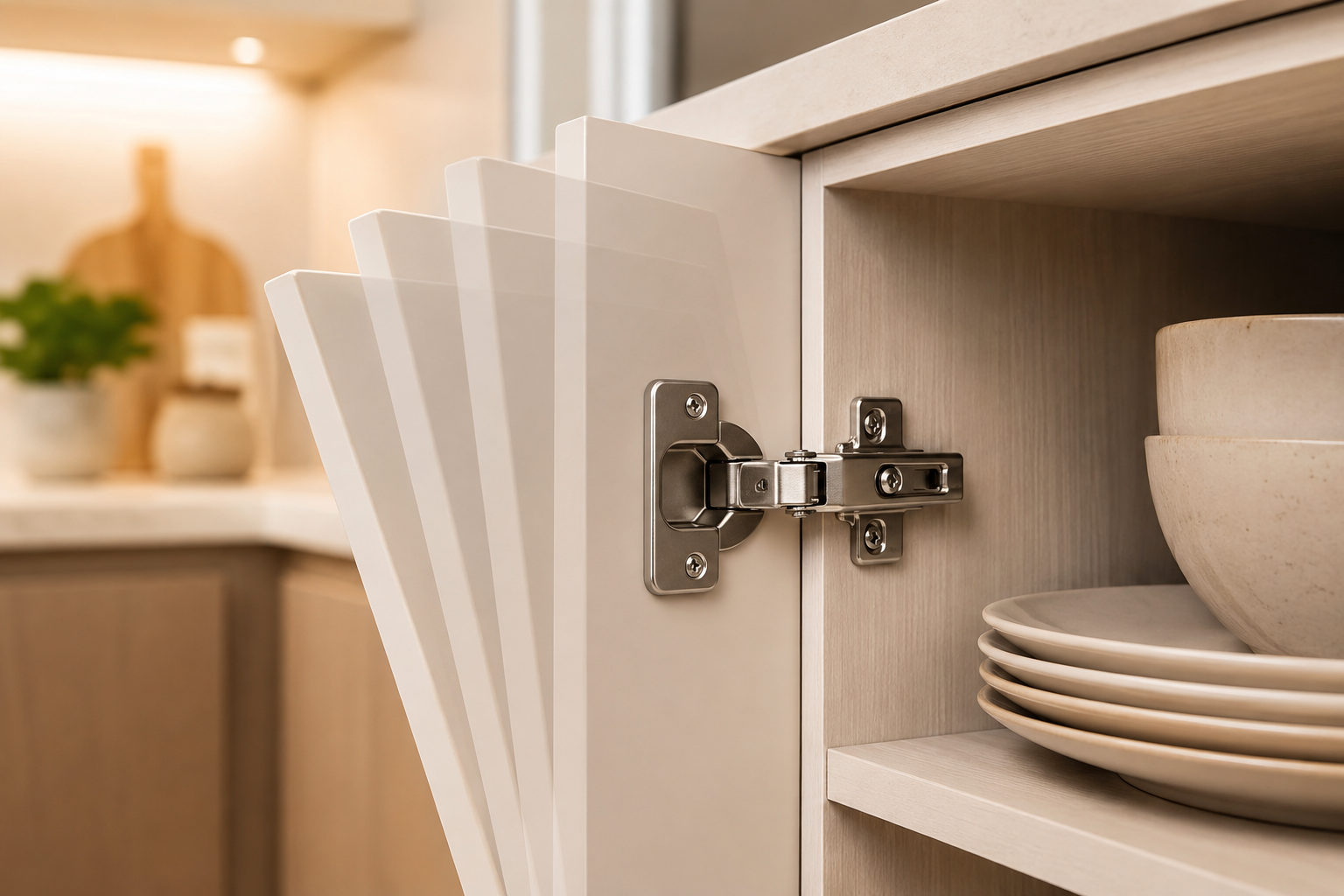
How Soft Close Cabinet Hinges Work
At the core of every soft close hinge is a small piston or spring loaded damper. As the door swings toward closed, the mechanism engages a few inches before contact and slows the motion down, so the door glides shut instead of snapping into place. Some models build this damper directly into the hinge body, while others use a clip-on cushioning device that can be added to a standard hinge. Either way, the physics are the same: kinetic energy gets absorbed gradually rather than released all at once against the cabinet frame.
This is different from a soft close drawer slide, which uses a similar idea but for horizontal motion rather than a swinging door. Both systems share the same goal, but the hardware inside them is built for very different jobs.
Benefits of Soft Close Hinges for Kitchen Cabinets
The obvious win is the noise reduction, but that is really just the beginning. Soft close hinges for kitchen cabinets also reduce wear on the wood, the paint, and the hardware itself. Every slam sends a small shockwave through the door and frame, and over years that adds up to loosened screws, chipped paint, and warped panels. This matters even more when the doors are made from a quality material, and choosing the best wood for kitchen cabinets only pays off if the hardware protects that investment day to day.
There is also a practical safety angle, especially in homes with young kids or pets. A slow closing door is far less likely to pinch a finger or startle someone standing nearby. And from a resale standpoint, soft close hardware reads as a small but meaningful upgrade to anyone touring a home, the same way updated lighting or a new faucet does. It signals that the kitchen has been cared for.
Types of Soft Close Cabinet Hinges
Not every cabinet door is built the same way, so hinges are categorized by how the door sits relative to the cabinet frame.
Full overlay soft close cabinet hinges are used when the door almost completely covers the cabinet box, leaving only a thin reveal between doors. This is the most common style in modern kitchens.
Concealed soft close cabinet hinges sit hidden inside the cabinet when the door is closed, so nothing is visible from the outside. These are popular for a clean, streamlined look and are compatible with most frameless cabinet construction.
Inset cabinet hinges are built for doors that sit flush inside the frame rather than overlapping it. These require more precise adjustment since there is very little margin for error, but they give cabinetry a custom, furniture like appearance. Overlay amount and door thickness both depend on box construction, so it helps to know how deep are kitchen cabinets built in your home before ordering replacement hardware.
Knowing which category your cabinets fall into before you shop will save a lot of back and forth, since hinges are rarely interchangeable across these three styles.
Blum and Blumotion Soft Close Cabinet Hinges
Ask any cabinet installer which brand comes up most often and Blum will almost always be near the top of the list. Blum soft close cabinet hinges are known for smooth, consistent damping and a long service life, which is why they show up so frequently in custom cabinetry and higher end kitchen remodels.
Blumotion, specifically, refers to Blum's integrated soft close technology, either built directly into the hinge or added as a separate clip-on unit for hinges that were not originally soft close. This flexibility is a big reason so many homeowners choose Blumotion hardware when upgrading older cabinets rather than replacing the doors entirely. Other well regarded brands include Hettich, Salice, and Grass, all of which offer similar functionality with slightly different adjustment mechanisms and price points. Once new hinges are in place, a little routine care goes a long way, and it is worth knowing how to clean cabinet hardware so the finish on your hinges and pulls stays consistent over time.
How to Choose the Best Soft Close Cabinet Hinges
The best soft close cabinet hinges for one kitchen are not necessarily the right choice for another, so it helps to work through a few questions first.
Start with the overlay type your doors need, since this narrows the field considerably. From there, consider the weight of your doors. Heavier doors, like those with glass panels or solid wood construction, need a hinge rated for that extra load, or the soft close action will feel weak or inconsistent. Look for hinges with adjustable tension, since this lets you fine tune the closing speed to match the door weight exactly.
Finally, factor in how many hinges each door will need. Taller or heavier doors typically require three hinges instead of two for even support. Buying the right quantity up front avoids a second trip to the hardware store.
Replacing Cabinet Hinges With Soft Close
Replacing cabinet hinges with soft close versions is one of the more approachable upgrades a homeowner can tackle without hiring a professional, as long as the new hinges match the existing hole pattern.
Begin by removing one door and taking a close look at the current hinge. Measure the boring hole diameter, the distance between mounting screws, and the overlay type. Many hardware brands offer soft close hinges designed as direct replacements for older non soft close models, which means the existing drilled holes will often line up without any new cuts needed.
Once you have a matching hinge, remove the old hardware, mount the new hinge body to the door and the mounting plate to the cabinet frame, then reattach the door and check the swing. If the holes do not line up with a direct replacement option, a soft close hinge insert or add-on damper is usually a simpler fix than re-drilling the door entirely. If you are already budgeting for new hardware alongside other upgrades, it is worth reviewing the cost to install kitchen cabinets so hinges, boxes, and labor are all accounted for in one plan.
How to Adjust Soft Close Cabinet Hinges
Even a well installed hinge sometimes needs a little fine tuning, and this is normal. Most soft close hinges have two or three adjustment screws: one for depth, one for height, and one for side to side positioning. If a door is not sitting flush or is catching on a neighboring door, small turns of these screws usually solve it.
The soft close tension itself is often adjustable too, either through a separate screw on the hinge or a small lever near the damper. Turning this clockwise typically increases resistance for a slower close, while counterclockwise loosens it for a quicker one. It is worth adjusting gradually and testing the door after each small turn, since a little movement makes a noticeable difference in how the door feels when it closes.
Soft Close Cabinet Hinges for Old Cabinets
A common misconception is that soft close hardware only works on new cabinetry, but that is not the case. Soft close hinges for old cabinets are widely available, either as full replacement hinges built to fit older hole patterns or as add-on dampers that clip onto the existing hinge arm without removing anything.
This makes soft close an easy weekend upgrade for a kitchen that otherwise does not need a full remodel. It is one of the more cost effective ways to make an older kitchen feel more current, since the improvement is felt every single time a cabinet door is used, not just noticed once and forgotten. If the boxes themselves are showing their age beyond the hardware, it is also worth checking how long do kitchen cabinets last to decide whether a hinge upgrade alone is enough or whether it makes sense to plan for something bigger down the road.
Final Thoughts
Soft close cabinet hinges are a small piece of hardware with an outsized impact on how a kitchen actually feels to live in day to day. Whether you are outfitting a brand new set of cabinets or upgrading hinges on doors that have been slamming for years, matching the right hinge type, brand, and adjustment to your specific cabinets makes the difference between a hinge that feels flimsy and one that works smoothly for years to come. For more inspiration on pairing new hardware with a broader refresh, our guide to kitchen cabinet remodel ideas is a good next stop.
If you are planning a kitchen update anywhere in Middle Tennessee, soft close hardware is one of the easiest upgrades to fold into a larger project. Our team handles kitchen remodeling in Nashville, TN, kitchen remodeling in Franklin, kitchen remodeling in Brentwood, Spring Hill, Murfreesboro, Thompson's Station and Columbia, and we would be glad to help you choose hardware that matches the rest of your cabinetry.