Framed vs Frameless Cabinets: Which One Fits Your Kitchen Best?
Framed vs frameless cabinets is one of those choices that seems small on paper but quietly shapes how your whole kitchen feels day to day. Most people don't think about cabinet boxes until they're standing in a showroom, staring at two doors that look almost identical from the front. Then the questions start piling up. Which one lasts longer? Which one gives me more storage? Which one is going to age well in ten years? I've had this conversation with a lot of homeowners over the years, and the honest answer is that both styles are good. They just solve different problems.
Let's walk through it the way I'd talk you through it if we were sitting across the table with a coffee.
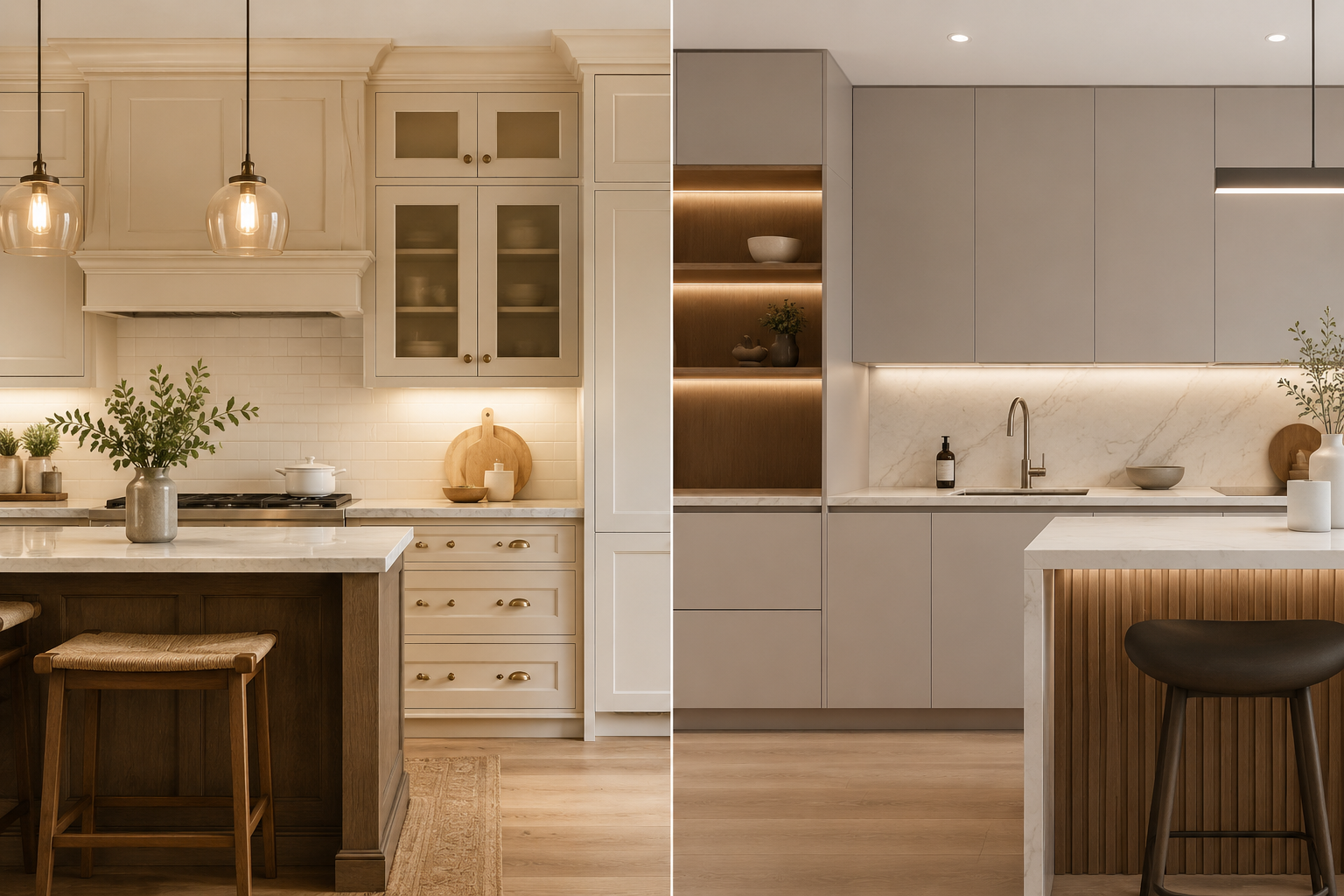
Frameless Cabinets vs Framed: What Actually Sets Them Apart
The difference is right there in the name. A framed cabinet has a thin wood frame attached to the front of the box. That frame is what the door hinges onto, and it's what gives the cabinet its structure at the face. Frameless cabinets skip that step entirely. The doors mount directly to the sides of the box, which is why some folks still call this style "European," since it took off overseas first.
You can spot the difference in a few seconds. Open a door. If you see a lip of wood running around the inside of the opening, it's framed. If the opening looks clean and boxy with almost no border, it's frameless.
Neither one is objectively better. They're built on different assumptions about how a kitchen should look and function, and both have earned their place in American homes.
Face Frame vs Frameless Cabinets: The Construction Basics
Face frame cabinets have been the standard in American kitchens for decades. The frame adds rigidity, which means the box itself can be built with slightly thinner side panels without giving up strength. That same frame also gives cabinetmakers a lot of flexibility with door overlays, inset options, and hinge placement.
Frameless cabinets rely on the box for all of their structure. To do that safely, the sides, top, and bottom are usually thicker, often 3/4-inch plywood or a good engineered panel. Construction is more sensitive to precision. Everything has to be square, because there's no frame to cover small gaps or forgive minor mistakes.
If you like the idea of tight tolerances and a modern silhouette, frameless plays to that. If you like the classic feel of a visible frame around each door, framed still wins on personality.
Framed Cabinets vs Frameless Cabinets: Pros and Cons
Here's the honest breakdown, without dressing it up.
Framed cabinets give you a traditional look, more forgiving construction, and easier hinge adjustment down the road. The trade-off is that the frame takes up interior space. When you reach into a drawer or cabinet, you can feel that strip of wood your hand has to pass over.
Frameless cabinets give you full access to the interior, wider drawers, and a cleaner face. The trade-off is that they show flaws more clearly. Sloppy installs look bad. Cheap frameless cabinets look really bad. There's nowhere for a poorly cut door to hide, and no frame to soften the eye.
For most kitchens, the choice comes down to whether you care more about maximum storage access or a classic American look. Both are valid answers.
Face Frame Cabinets vs Frameless: Storage and Access
This is where numbers actually start to matter. A frameless cabinet gives you roughly 10 to 15 percent more usable interior space than a comparable framed one. That may not sound huge, but if you're sliding a sheet pan in or trying to fit a stand mixer inside a base cabinet, that extra room shows up fast.
Drawers are where the gap is most obvious. In a frameless cabinet, drawer boxes can run nearly the full width of the opening. In a framed cabinet, they have to be narrower so they can clear the frame. If you love deep, wide drawers for pots, pans, and everything in between, frameless is going to feel more generous the first time you open one.
That said, framed cabinets aren't cramped. They just have a slightly different relationship with the space inside them, and plenty of families have cooked comfortably in framed kitchens for generations.
Frame vs Frameless Cabinets: Cost, Style and Longevity
Pricing is not as clean as most articles make it sound. Framed cabinets used to be the cheaper option because American factories were tooled to produce them at scale. That's shifted. Today, high-end framed cabinets from custom shops can cost more than mid-range frameless lines, and budget frameless imports can undercut both.
As a rough guide, expect frameless to run slightly higher when you're comparing similar quality tiers. The thicker panels and tighter tolerances cost more to build. Installation labor can also be a little higher, since there's less room for on-site adjustment once the boxes hit the wall.
When it comes to longevity, both styles hold up if they're built and installed well. What kills a cabinet is usually water, cheap hinges, or thin box material, not the presence or absence of a frame. If you invest in solid construction and good hardware, either style will still be doing its job in twenty years.
Framed vs Frameless Kitchen Cabinets: Which One Feels More Like You
Think about what you want your kitchen to feel like when you walk in each morning.
If you're drawn to farmhouse, transitional, or classic Craftsman looks, framed cabinets tend to sit more naturally in those styles. The visible frame gives doors a grounded, built-in look that pairs well with beadboard, shaker panels, warm wood tones, and traditional hardware.
If you lean toward sleek, modern, or contemporary designs with flat panel doors, minimal hardware, and long seamless runs of cabinetry, frameless is going to give you that cleaner line. It's also more forgiving of European-style handleless doors and integrated appliance panels.
There's no rule that says a shaker door needs a frame or a slab door needs to be frameless. It's more about the overall vibe you're building and how the cabinets need to sit next to your countertop, flooring, and light.
Framed vs Frameless Shaker Cabinets: Same Look, Different Build
Shaker doors are the most popular door style in American kitchens right now, and they work beautifully on both framed and frameless boxes. From across the room, you probably can't tell the difference. Up close, framed shaker doors have that thin border of frame around each one, which reads as more traditional. Frameless shaker doors sit closer together with narrow reveals between them, which reads as more contemporary.
If you're renovating a historic home, a framed shaker often blends more comfortably with the original character. If you're finishing a new build with tall ceilings and clean lines, frameless shakers usually look more intentional and modern. Both are good choices. Neither one is wrong.
Frameless vs Framed Kitchen Cabinets: Pros, Cons, and How to Choose
I tell every client the same thing. Pick the style that solves your problem, not the one you think you're supposed to pick.
Ask yourself a few honest questions:
Do I need every inch of storage I can get? Lean frameless. Do I want a classic American kitchen with visible cabinet frames? Go framed. Am I working with the character of an older home? Framed usually blends better. Am I chasing a modern, minimal look? Frameless will get you there faster. Am I working with a tight budget? Get real quotes on both styles before you decide.
Also think about who's actually building and installing them. Frameless cabinets are less forgiving during install. If your walls are out of square or your floors slope, which is very common in older homes, a well-done framed install will often look cleaner than a rushed frameless one. Pick your builder before you pick your box style. The craftsmanship matters more than the category.
The Long View
Ten years from now, both styles will still look good if they were built well and installed with care. The differences that seem huge in a showroom shrink once you're actually living with your kitchen. What you'll notice every day is how the drawers pull, how the doors close, and how the finish holds up around the sink and stove. Those things depend more on hardware and construction quality than on whether there's a frame on the front.
So take your time. Look at both styles in person. Open drawers. Close doors. Run your hand along the inside of the boxes. You'll know pretty quickly which one feels right for the way you cook and live.
If you're planning a kitchen remodel around Middle Tennessee, we'd be glad to help you think it through. SH Design Woodcraft builds custom kitchen cabinets for homeowners in Kitchen remodeling Nashville, TN, Franklin, Brentwood, Spring Hill, Murfreesboro, Thompson's Station and Columbia. Whether you land on framed or frameless, the goal is the same. A kitchen that works hard, looks honest, and holds up for years.