Waterfall Edge Countertop: The Cabinet Maker's Guide to Getting It Right
A waterfall edge countertop is one of those design details that looks effortless in a photo and turns brutal in the shop. The slab has to be book-matched, the miter has to close to a hairline, and the cabinet underneath has to carry weight it was never really designed to hold. Homeowners across Middle Tennessee ask us about it almost every week now, usually after seeing one on Instagram, and the honest answer is that a waterfall edge countertop works beautifully when the fabricator, the cabinet maker, and the designer are on the same page from day one. When they are not, you end up with a chipped corner, a visible seam, or a slab that looks like it was glued together in a driveway. This guide walks through everything we tell our clients before they commit, from profile choices and material trade-offs to real installed cost in this market.
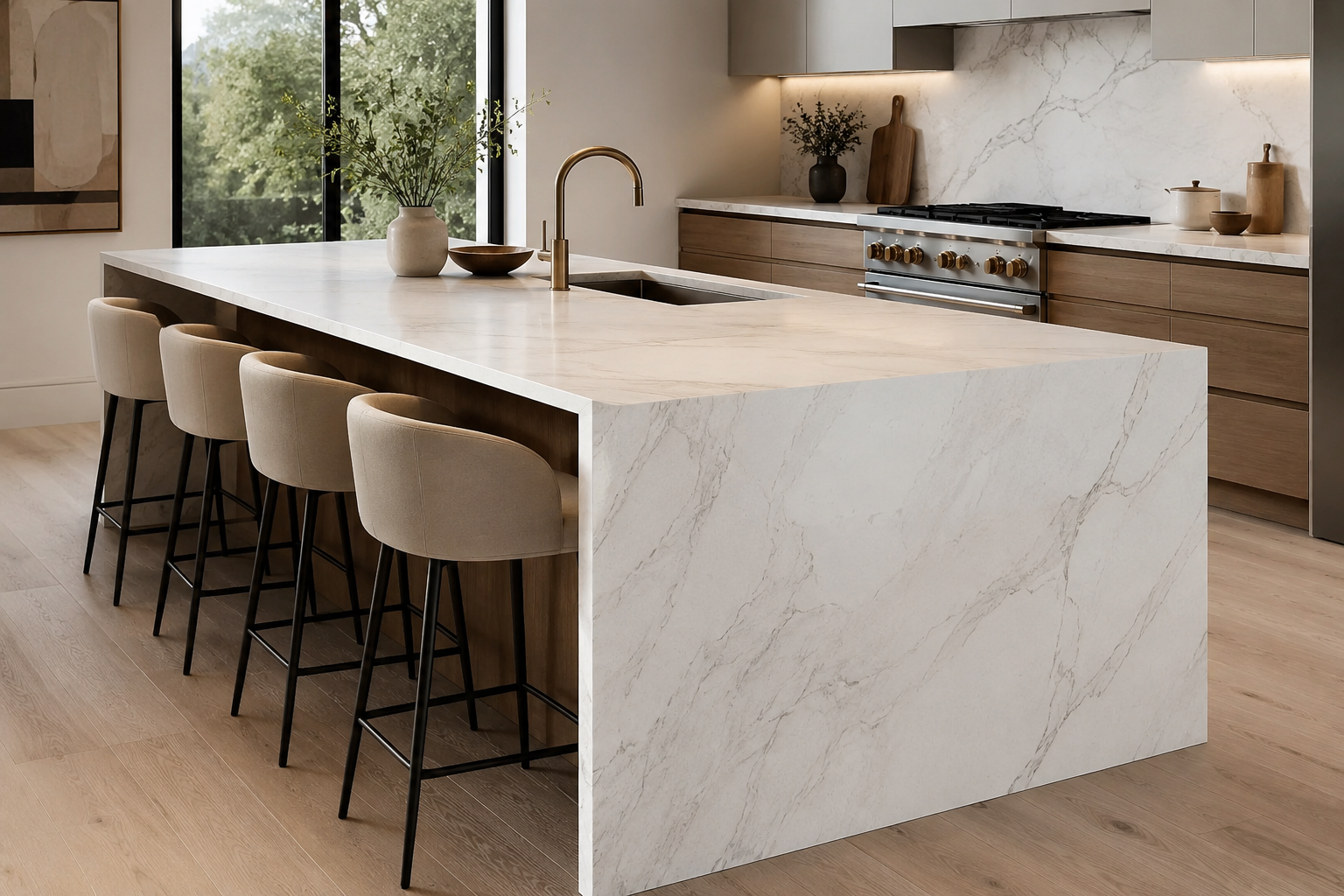
What Is a Waterfall Edge Countertop?
If you have been browsing kitchen photos and wondering what is a waterfall edge on a countertop, here is the plain version. Instead of the counter stopping at the edge of the cabinet with a normal apron or finished side panel, the countertop material continues down the side, all the way to the floor, at a 90 degree angle. The stone, wood, or laminate "falls" over the edge like water pouring off a shelf. That vertical piece is not decorative cladding stuck onto plywood. On a proper installation, it is the same slab, cut and mitered so the grain or vein continues around the corner without a visible break.
That continuity is the whole point. A countertop with waterfall edge is really a visual statement that says the material matters enough to be seen from every angle. It also protects the side of the cabinet from foot scuffs, dog tails, and vacuum cleaner dings, which is a quiet practical benefit nobody talks about.
Waterfall Countertop Edge Profile: How the Cut and Miter Actually Work
The waterfall countertop edge profile is where craft separates a nice job from a great one. There are two ways to build this transition, and they are not equal.
The first is a butt joint. The horizontal top meets the vertical panel at a flat 90, with the seam visible along the top corner. It is faster, cheaper, and forgiving on cheap material, but the seam reads from across the room. We rarely recommend it.
The second is a mitered edge waterfall countertop, where both pieces are cut at 45 degrees and joined so the seam sits at the outside corner. Done well, the vein or grain flows continuously and you have to be six inches away to spot the joint. This is what people mean when they show you a magazine photo. It is also where fabricators earn their money, because a 45 on a heavy slab of quartz or granite has almost no room for error. A poor miter chips within a year of normal kitchen use.
For wood, the language changes but the idea is the same. Laser edge banding with waterfall countertops cabinetry is a technique used mostly on engineered wood and high-pressure laminate builds, where a laser fuses the edge banding to the substrate for a seamless line without a glue bead. It is common in modern European style kitchens and pairs well with flat-panel cabinet fronts.
Waterfall Countertop Edge Pros and Cons
Every client asks about waterfall countertop edge pros and cons eventually, so here is the version we give in the showroom instead of the version you read on manufacturer blogs.
The pros are real. A waterfall edge on countertop elevates an ordinary island into a focal point. It protects cabinet sides from wear, hides the toe kick line cleanly, and pairs beautifully with modern, transitional, and even some traditional kitchens. It also boosts resale perception, because buyers walking through a home read it as a considered, custom detail.
The cons are equally real. Cost goes up meaningfully, because you are buying more material and paying for a precision miter. Repairs are harder, since a chip on the corner may mean replacing the vertical panel, not just filling the ding. Some materials, especially heavily veined natural stone, are difficult to book-match, and a bad match makes the seam scream instead of whisper. And if the cabinet underneath is not built to support the extra weight, the panel can develop a stress crack over time. This is why we push clients hard toward custom cabinetry when a waterfall is on the plan. A stock big-box cabinet was not designed for it, which is one of the honest reasons we wrote our comparison ofhome depot kitchen cabinets vs custom in the first place.
Quartz Waterfall Edge Countertop and Other Material Choices That Actually Change the Job
Material dictates everything about a waterfall build. Here is how each one behaves in the real world.
A quartz waterfall edge countertop is the workhorse of this category, and for good reason. Engineered quartz has a consistent pattern across the slab, which makes book-matching predictable. It resists chipping better than most natural stones at a mitered corner. Colors like Calacatta-look quartz give you the marble drama without the maintenance headache. If you are picking one material for a first waterfall, this is it. In our shop, roughly seven out of ten waterfall installs we spec now are a waterfall edge quartz countertop.
A waterfall edge granite countertop is the classic option. The advantage is that no two slabs are alike, so your kitchen has a piece nobody else owns. The disadvantage is that heavy veining is unpredictable, and a bad miter turns a $6,000 slab into a talking point for the wrong reasons. We ask clients to visit the stone yard and physically approve the slab before it gets cut. No exceptions.
A concrete countertop waterfall edge is a specialty build. Concrete is poured in a form to the exact geometry, so the miter is really a monolithic pour rather than a cut. The look is heavy, honest, and industrial. It suits a certain kind of kitchen, usually one with metal accents, dark cabinets, and open shelving. The trade-off is weight. A concrete waterfall panel is significantly heavier than stone, and the cabinet framework needs blocking to carry it safely.
A butcher block countertop with waterfall edge, or the closely related waterfall edge wood countertop, gives warmth that stone simply cannot match. The catch is expansion. Wood moves seasonally, and a mitered wood corner without the right joinery will open up in dry Tennessee winters. We use splined miters with hidden fasteners and finish with a hard-wax oil that lets the wood breathe.
A live edge waterfall countertop pushes this further. Instead of a flat mitered edge, the natural bark edge of the slab flows over the side. It is stunning on a single-slab island and completely wrong for a family kitchen with kids who bang plastic cups on corners. Know what you are signing up for.
A laminate countertop with waterfall edge, or specifically a diy laminate countertop waterfall edge attempt, is the budget path. Modern high-pressure laminates look better than they used to, especially in stone-look prints, and laser edge banding hides the joint impressively well. If your budget is tight and your priority is the look, this is a legitimate route. Just be honest with yourself that it will not last the way stone does.
Waterfall Edge Countertop Island: Why This Feature Belongs on Your Island (and Almost Nowhere Else)
Nine out of ten waterfall installs are on an island, and there is a reason. A waterfall edge countertop island is visible from all four sides, sits in the middle of the room, and doubles as a design anchor. Every other counter run in the kitchen usually terminates against a wall or an appliance, which kills the waterfall effect before it starts.
A waterfall edge island countertop also solves a specific problem: how do you finish the exposed sides of an island without them looking like an afterthought? Cabinet-matched panels work, but they compete visually with the top. A waterfall unifies the whole piece into one sculptural object. If you are still thinking through island sizing, seating, and overhang, our full guide tokitchen island with seating goes deep on the dimensions and layout math that make an island genuinely usable rather than just photogenic.
One place people ask about but should usually skip: a kitchen countertop waterfall edge on a peninsula that meets a wall. The waterfall only shows on one side, which defeats most of the visual payoff and costs almost the same as doing both sides on an island. Save the money for a better slab.
Waterfall Countertop Edge Detail: Design Choices That Make or Break the Look
The waterfall countertop edge detail is a rabbit hole most homeowners do not realize exists until they are standing in front of the slab. A few of the calls that actually matter:
Slab thickness. A 3 cm slab reads substantial and holds up structurally at a miter. A 2 cm slab looks thin at the corner and is more prone to chipping. We spec 3 cm on every waterfall we build. Waterfall edge countertops in 2 cm can work with a built-up mitered edge to fake thickness, but it adds fabrication complexity.
Vein direction. On a book-matched slab, the vein should flow off the horizontal top and continue down the vertical panel without a jump. That means the fabricator has to lay out the cuts before touching the saw. Cheap fabricators skip this step and you end up with a vein that runs west on top and south on the side.
Toe kick treatment. A true waterfall lands flat on the floor with no toe kick recess. Some clients want a small reveal at the bottom for cleaning access. Both are defensible. Decide before the cabinet is built, because a retrofit is ugly.
Flooring interaction. If your floor is not level, the waterfall panel will show it. We shim the cabinet before the top is templated, not after. This is the difference between a five-figure installation that lasts twenty years and one that develops a visible gap in month three.
Waterfall Edge Countertops in Modern Kitchen Remodels
Waterfall edges on countertops became a signature detail of contemporary and transitional kitchens for a reason. They pair naturally with flat-panel cabinets, integrated pulls, and horizontal grain veneers. They also work surprisingly well with warm wood cabinetry, where the stone waterfall becomes the cool counterweight to the warm cabinet color. What they do not pair well with is heavy traditional detailing. Raised panels, ornate crown, and a stone waterfall fight each other visually.
If you are earlier in the process and still working through cabinet direction, our full breakdown ofkitchen cabinet remodel ideas covers wood species, colors, and door styles that pair intelligently with statement countertops rather than compete with them. Getting the cabinet layer right first makes every countertop decision easier.
Countertops with waterfall edge also change how you plan storage. The side of the island that carries the waterfall cannot have drawers or doors opening into it. That storage has to move to the other side. If your kitchen leans small, that reshuffle is worth thinking about carefully. Our guide ondesign for kitchen cupboards covers how to plan that flow without losing usable storage in the trade.
Waterfall Edge Countertop Cost: What to Expect in Middle Tennessee
Real numbers, not the hedged ranges you see on national sites. A waterfall edge countertop cost in the Nashville, Franklin, Brentwood, and Spring Hill market currently runs roughly like this, installed:
Waterfall edge quartz countertop on a standard island (roughly 3 feet by 7 feet with two waterfall ends): about $4,500 to $7,500 depending on the quartz brand and pattern.
Waterfall edge granite countertop: about $4,000 to $9,000, with the spread depending heavily on the exotic level of the slab.
Concrete countertops waterfall edge: about $5,500 to $10,000, because it is a specialty trade with fewer fabricators.
Waterfall edge butcher block countertop: about $3,500 to $6,500 for a solid hardwood build with a proper splined miter.
Laminate waterfall edge countertop: about $1,800 to $3,000 for a professionally installed build with laser edge banding.
These numbers assume no unusual structural work under the island. For a broader look at where countertops fit into the total remodel budget, our full breakdown on thecost to replace kitchen countertops puts these figures in context against materials without a waterfall edge, so you can see exactly what the feature adds. If your overall project budget is tight, our notes oninexpensive kitchen remodel ideas cover where to trim without hurting the final look.
Waterfall Countertop Edge Images: What to Look For When You Are Browsing
Most homeowners collect a folder of waterfall countertop edge images before they ever call us. When you are looking, pay attention to three specific things instead of the overall vibe.
First, look at the corner where the top meets the side. Is the miter clean, or can you see a dark line? A dark line means the fabricator did not polish the miter edges before joining, which is a shortcut that shows for the life of the counter.
Second, look at the vein. Does it continue from the top down the side, or does it jump? A book-matched slab reads as one piece even in a phone photo. A non-matched job reads as two pieces stuck together.
Third, look at the bottom. Does the waterfall panel meet the floor cleanly, or is there a visible gap or an awkward baseboard interruption? That gap is a symptom of a cabinet that was not planned for the waterfall from the start.
Waterfall Edges on Countertops: The Questions We Get Asked Most
Are waterfall edges on countertops still in style in 2026? Yes, and probably for a long run. They have moved from trend to accepted contemporary staple, similar to shaker doors and quartz surfaces.
Can you add a waterfall to an existing countertop? Almost never in a way that looks right. The vein and color match a new slab from the same lot, and old slabs rarely have leftovers stored.
Does a waterfall edge damage easily? The horizontal top is fine. The vertical panel corners can chip if hit by hard objects, which is why 3 cm material and a good miter are worth the money.
Do you need special cabinets underneath? Yes. The cabinet has to be built to carry the extra weight and to give the fabricator a clean, level substrate. This is where custom work pulls ahead of stock.
Ready to Plan a Waterfall Edge Countertop Kitchen in Middle Tennessee?
A waterfall edge countertop is a beautiful detail, and it is also one of the least forgiving features in a kitchen. It rewards planning and punishes shortcuts. At SH Design Woodcraft, we build the cabinetry, coordinate the fabrication, and manage the install as one job with one point of accountability, so the miter closes, the vein flows, and the panel meets the floor the way it was drawn. If you are planning a project in the area, we work with homeowners on kitchen remodeling inSpring Hill,Franklin,Brentwood,Nashville,Murfreesboro, Columbia, and Thompson's Station. Reach out when you are ready to walk through slabs, cabinet direction, and the details that make a waterfall look like it was always meant to be there.