Butcher Block Countertops: What Actually Works, What Doesn't, and What Nobody Tells You
Most guides you'll read about butcher block countertops were written by people who have never installed one, sealed one after a plumbing leak, or stood next to a homeowner explaining why the seam near the sink split open in year two. This one is different. We build kitchens for a living across Middle Tennessee, and we've put butcher block countertop runs into a lot of them, plus we've torn a fair number out. This is the guide we wish clients had read before their first showroom visit.
If you're weighing wood against quartz, granite, or laminate, you probably already like the look. What you actually need to know is where wood shines, where it fails, and how to spec it so it lasts twenty years instead of two.
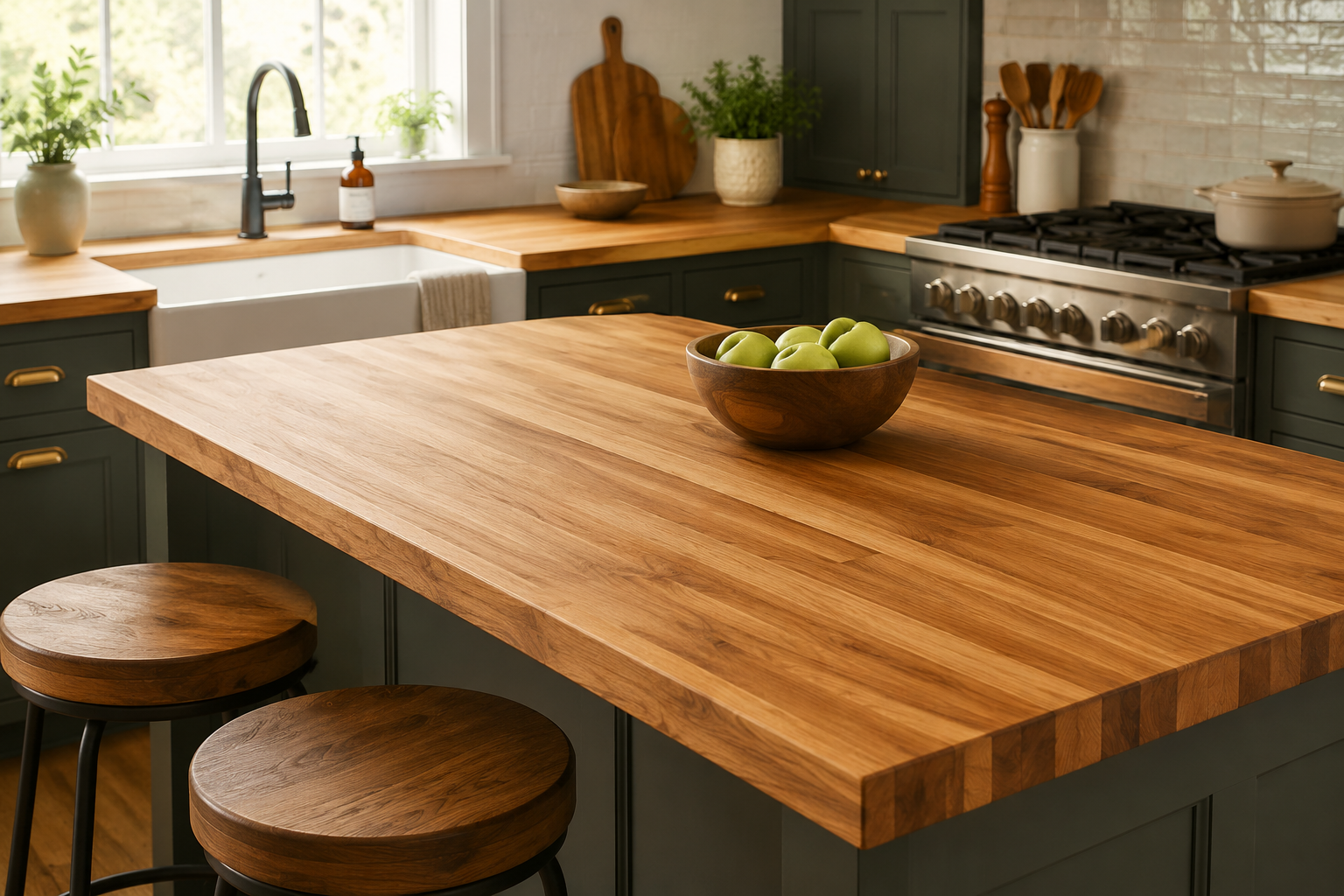
What Butcher Block Countertops Actually Are (And Why Grain Direction Matters More Than Wood Species)
A butcher block countertop is a slab built from strips of hardwood glued together. Sounds simple. The part that gets glossed over on every big-box product page is grain direction, and it's the single biggest factor in how the counter performs.
There are three grain styles you'll see:
Edge grain is the most common. Long strips of wood laid on their side and glued edge to edge. You see the long grain on top. Strong, affordable, stable. This is what Lowe's, Home Depot, and IKEA sell as their standard butcher block countertop.
End grain stands the wood fibers up so you're looking at the ends of the boards, like a checkerboard of tiny squares. This is the classic professional butcher's block. Self-healing when a knife hits it, gorgeous, and roughly two to three times the price. An end grain hickory butcher block countertop on a kitchen island is a statement piece.
Face grain shows the widest, flattest face of the board and reads like a plank floor turned into a counter. Beautiful figure, but softer under impact than edge or end grain. Best on a bar top or island where knives don't live.
If a product listing doesn't tell you which grain type it is, assume edge grain. That's almost always what's in stock.
Butcher Block Countertops Pros and Cons (The Version Written by Someone Who Installs Them)
You'll find a hundred lists of butcher block countertops pros and cons online. Most are polite. Here's the version we give clients.
Pros:
Warmth that stone can't touch. In a kitchen full of white cabinets, wood is the element that keeps the room from feeling like a hospital.
Genuinely repairable. Scratched a quartz counter? Live with it. Scratched wood? Sand it, re-oil it, done.
Knife-friendly if you don't mind cut marks (edge and end grain are the friendliest).
Cheaper than quartz or granite by 30 to 50 percent per linear foot at the entry level.
DIY-installable for a handy homeowner. Try that with a stone slab.
Cons:
Water is the enemy. Every failure we've seen traces back to standing water at the sink, dishwasher, or a leaky faucet nobody noticed for three weeks.
Requires maintenance. Not a lot, but not zero. If you never want to think about your counter again, get quartz.
Heat marks. A hot pan set directly on wood will leave a scorch you cannot sand out.
Movement. Wood expands and contracts with humidity. A ten-foot run can move a full quarter inch across the seasons. If your installer doesn't allow for that, you'll get splits.
Not ideal for homes that are empty for long stretches with the HVAC off. The humidity swing kills the finish.
The honest butcher block countertops pros cons verdict: it's a fantastic material for people who actually cook and are willing to wipe up water. It's a bad material for people who want a "set it and forget it" surface.
Best Wood for Butcher Block Countertop: A Ranking That Isn't Marketing Copy
The best wood for butcher block countertop depends on what you're doing with it. Here's how the common species actually perform, ordered by Janka hardness (higher = harder).
Hard Rock Maple (1450 Janka). The default for a reason. A hard rock maple butcher block countertop or solid maple butcher block countertops slab is dense, closed-grain, light in color, and takes finish evenly. If you're picking blind, pick maple. This is what a john boos blended maple butcher block countertop uses and why it dominates the mid-price market. Almost every maple butcher block countertop you'll see quoted is this species.
Hickory (1820 Janka). Harder than maple with dramatic light-to-dark color variation. Rustic look, less predictable stain response. Beautiful on a farmhouse island.
Walnut (1010 Janka). A walnut butcher block countertop is the luxury pick. Rich chocolate tones, softer than maple so it dents easier, roughly double the price. Stunning on an island paired with white perimeter cabinets.
White Oak (1360 Janka). Increasingly popular in modern kitchens. Open grain, so it needs a good sealer, but the look is unbeatable in a transitional space.
Cherry (995 Janka). Softer, darkens beautifully with age. Best as a decorative accent, not a work surface.
Acacia (2300 Janka). Very hard, warm exotic tones. Acacia butcher block countertops are the bargain of the "premium looking" tier because Asian-sourced acacia is cheaper than domestic walnut. Grain can be busy.
Birch. Birch butcher block countertops are the entry-level option, lighter and softer than maple. Fine for a laundry room, not what we'd spec for a heavy-use kitchen.
Bamboo. Technically a grass, but sold as butcher block. Extremely hard, sustainable, but the glue lines can telegraph over time.
The butcher block countertops maple vs walnut question comes up every week in our shop. Short answer: maple for a work surface, walnut for the showpiece island. That two-material approach is where most kitchens with butcher block countertops end up.
Butcher Block Kitchen Countertops: Design Combinations That Actually Work
Instead of listing generic ideas, here's what we see hold up in real Middle Tennessee kitchens.
White cabinets with butcher block countertops. The default for a reason. White cabinets with butcher block countertops in maple hit the classic modern farmhouse note. If you want more contrast, pair white shaker doors with a walnut top on the island only. If you want less contrast, use light maple everywhere.
Dark cabinets with a light top. Navy or forest green lowers with a maple butcher block countertops run reads as high-end without feeling try-hard. This is the direction we're steering more clients in 2026, and it pairs cleanly with the color and style choices in our kitchen cabinet remodel ideas guide.
Two-tone with a wood island. Painted perimeter, natural wood island. A butcher block island countertop in walnut or end grain hickory becomes the heart of the room. Waterfall the ends if the budget allows.
Dark stained butcher block. A dark butcher block countertop, black butcher block countertop, or grey butcher block countertop is achievable with the right stain and topcoat, but you're giving up the ability to re-oil casually. Staining butcher block countertops locks you into a full refinish cycle instead of a wipe-on maintenance cycle. Worth knowing before you commit.
Butcher block countertop and backsplash. Running the wood up the wall as a butcher block countertop backsplash looks incredible in photos and is a maintenance headache in real life. Wood behind a sink or range gets grease and steam. If you love the look, do it behind a bar or coffee station instead.
The picks above assume you already know the cabinet direction. If you don't, our guide on best wood for kitchen cabinets is worth reading first because your cabinet species will drive the countertop pairing.
Butcher Block Island Countertop: Why This Is Usually the Right Play
If you take one piece of advice from this article, take this one. For most homeowners, a butcher block island countertop with quartz or stone on the perimeter is a smarter kitchen than full-run butcher block.
Why: the island is where you prep, roll dough, and gather. It doesn't have a sink or a dishwasher. It doesn't sit under a range. It's the perfect application for wood because the two things that kill butcher block, standing water and heat, aren't in play. The perimeter, where the sink and range live, gets the material that shrugs off water and heat.
We call this the two-material kitchen, and it's the setup we recommend to about 70 percent of clients who come in asking for full butcher block. A kitchen island butcher block countertop paired with quartz perimeter gives you the wood you wanted, without the failure modes.
If you're planning a full remodel from scratch, this is one of the layout decisions worth locking in before cabinet drawings, and it's the kind of pairing our custom cabinetry for new construction team designs around from day one.
Prefab vs Custom Butcher Block Countertops: An Honest Comparison
You have three real buying paths.
Big-box prefab. A butcher block countertop lowes slab, butcher block countertops home depot unit, ikea butcher block countertops, butcher block countertop menards stock, or an allen roth butcher block countertops run all live here. Fixed sizes, usually 25 inches deep, 6 to 12 feet long. An ikea butcher block countertop is the cheapest per foot, typically beech or oak, and honestly fine for a small kitchen or laundry room. A lowes butcher block countertop in maple or acacia is a solid mid-tier pick. A 10 foot butcher block countertop or 12 ft butcher block countertop from any of these is easy to source and DIY-friendly.
Online direct. Companies like John Boos and Hardwood Lumber Company ship made-to-order slabs in your species, thickness, edge profile, and finish. A butcher block countertop home depot listing is often actually a John Boos product with a markup, so you can sometimes save by going direct.
Custom. A local shop builds the slab to your kitchen. This is where custom butcher block countertops justify their price: exact lengths without seams, matched grain, integrated cutting boards, waterfall ends, or unusual thicknesses. You'll pay 40 to 80 percent more than big-box, and it looks like it.
Butcher block laminate countertop and faux butcher block countertop options exist too. A laminate butcher block countertop printed to look like wood costs a fraction of the real thing and is genuinely waterproof, but no one has ever mistaken it for wood in person. If budget is the driver, this is honest value. If look is the driver, you'll regret it.
How to Install Butcher Block Countertops (The Part Where People Mess Up)
We could write a book on how to install butcher block countertops, but here are the moves that separate a five-year install from a twenty-year one.
Acclimate the slab. Bring it into the kitchen for at least 72 hours before installing butcher block countertops. Wood that goes in cold and then warms up will crack.
Attaching butcher block countertop to cabinets is not the same as attaching stone. You cannot glue or hard-fasten a wood top to a cabinet frame. Wood moves. Stone doesn't. How to attach butcher block countertop correctly means using elongated slot holes or figure-8 fasteners that let the top expand and contract without splitting. Standard screws through a fixed hole will crack your counter within a year. Every DIY guide that says "screw it down from underneath" is wrong on this point.
Sink cutouts are where failures start. For an undermount sink, the exposed wood edge around the cutout has to be sealed on all six sides, top, bottom, and all four edges of the cut, with an epoxy or marine-grade finish before the sink goes in. Skip this and you'll have black staining and swelling within 18 months. For a drop-in sink, use a heavy bead of silicone under the sink lip and around the cut.
Allow expansion at the walls. Leave a 1/8-inch gap at each end run and cover with scribe molding. A tight-fit install in July will buckle by January.
Seams should be avoided if possible. A 10 ft butcher block countertop or 12 foot butcher block countertop can usually be single-piece. If you need a seam, put it away from the sink and use a butt joint with fasteners underneath, not just glue.
How to make a butcher block countertop from scratch is a real DIY project, and how to build a butcher block countertop with a planer, jointer, and clamps is a rewarding weekend build. But how to install butcher block countertop slabs you bought is the more common project, and that's what we've focused on here.
The cost to install butcher block countertops by a pro runs $8 to $15 per linear foot for a straightforward job, more with sink cutouts, seams, or scribing to uneven walls.
How to Seal Butcher Block Countertops (The Question With Two Right Answers)
How to seal butcher block countertops is the maintenance question that gets asked the most, and there are two legitimate approaches with very different lifestyles.
Option 1: Food-safe oil finish. Mineral oil, or a mineral oil and beeswax blend. This is the classic butcher block countertop sealer path. A mineral oil butcher block countertop feels warm, ages beautifully, and lets you prep food directly on the wood. Re-oil monthly for the first year, then quarterly. Any food safe oil for butcher block countertops works: mineral oil (cheapest and best), fractionated coconut oil, or a butcher block conditioner. Never use olive oil or vegetable oil. They go rancid.
Option 2: Film finish. Waterlox, tung oil, or a marine-grade polyurethane. This is a butcher block countertop finish that creates a hard sealed layer. Way more water-resistant than oil, but you can't cut on it and you can't touch up spot damage without stripping and refinishing the whole run. Not food-contact safe once cured, so you'd use a cutting board on top.
Our rule of thumb: oil finish on islands and prep zones, film finish on any wood that lives near a sink, and always film finish on a butcher block bathroom countertop or a butcher block countertop in laundry room.
How do you seal butcher block countertop step by step with oil:
Sand the surface with 220-grit if it's raw or roughed up.
Wipe clean.
Apply mineral oil generously with a lint-free cloth.
Let it soak in for 20 minutes.
Wipe off the excess.
Repeat until the wood stops drinking oil (usually three or four coats on new wood).
That's the whole process for sealing butcher block countertops. It takes 30 minutes.
How to Clean Butcher Block Countertops and Keep Them Looking Right
How to clean butcher block countertops day to day is embarrassingly simple: warm soapy water and a cloth. Don't soak the surface, don't leave standing water, don't use bleach or ammonia. That's the whole method.
For sanitizing (raw meat prep, for instance), a diluted white vinegar spray works and won't damage the finish. For stubborn stains, a paste of coarse salt and lemon juice, scrubbed with the grain, lifts most discoloration.
How to care for butcher block countertops longer-term:
Re-oil when the wood looks dry or water stops beading. This might be every month or every three months depending on humidity.
Sand out deep scratches or burn marks with 120-grit, working up to 220, then re-oil.
Address water rings immediately by rubbing with fine sandpaper and re-oiling.
Protecting butcher block countertops near appliances is worth a specific note. Put a small tile pad or trivet permanently next to the range for hot pans. Add a rolled-up towel or mat inside the sink base cabinet to catch drips from plumbing before they hit the underside of the wood. These two moves prevent 90 percent of the problems we see.
Butcher Block Countertop Cost: Real Numbers
How much are butcher block countertops in 2026? Ranges below are per linear foot at 25-inch depth, 1.5-inch thickness, including material and standard finish. Installation is separate unless noted.
Big-box prefab (birch, beech, entry acacia): $30 to $60/lf
Mid-tier prefab (maple, mid acacia): $50 to $100/lf
Premium prefab (butcher block countertops maple in solid, hickory, oak): $100 to $180/lf
Custom edge grain in walnut, cherry, or white oak: $150 to $300/lf
Custom end grain in any species: $250 to $500/lf
Waterfall ends, integrated cutting boards, matched seams: add 20 to 40 percent
Butcher block countertop prices vary regionally, but Middle Tennessee lands squarely in the middle of these ranges. Installation adds another $8 to $15 per linear foot for a clean prefab install, more for custom fitting.
Compare that to quartz ($60 to $150/lf installed) or granite ($50 to $200/lf installed), and butcher block is often the value pick, especially if you DIY the install.
When Butcher Block Is the Wrong Choice
Nobody writes this section, but it saves clients money. Skip butcher block countertops for kitchen work surfaces if:
The kitchen sits empty during long trips with HVAC turned off. Humidity swings will destroy the finish.
Nobody in the household wants to think about maintenance. Not a lot of maintenance, but not zero.
The sink is a drop-in on a small counter with no landing zone. Standing water is guaranteed and the wood will suffer.
You entertain a lot and set hot pans down without thinking. Wood scorches.
Resale is coming in under two years and the neighborhood comps are all quartz. Buyers in some markets read wood as dated.
For everyone else, wood is a fantastic material and easily one of the warmest surfaces you can put in a kitchen.
Planning a Kitchen Where Butcher Block Actually Belongs
The best wood counters live inside kitchens designed around them, not bolted on at the end. If you're weighing butcher block as part of a full remodel, our team designs cabinetry, layout, and countertops together so the wood ends up where it thrives and stone goes where wood would fail. Whether you're upgrading a single island or gutting the whole space, we handle it end to end. Get in touch to plan your project through our kitchen remodeling in Nashville, kitchen remodeling in Franklin, kitchen remodeling in Brentwood, kitchen remodeling in Spring Hill, or kitchen remodeling in Thompson's Station service pages.