Sideboard Kitchen Cabinet: A Smart Storage Upgrade for Tennessee Homes
Sideboard kitchen cabinet pieces solve two problems most Tennessee homes have at the same time: not enough storage and not enough usable surface area. Whether you're hosting Sunday dinner, building a coffee bar or just trying to hide the everyday clutter, the right sideboard pulls real weight in a busy kitchen. This guide walks through how they fit into modern kitchens, the style and size choices that matter and a practical DIY path if you'd rather build one yourself.
Kitchen Cabinets and Sideboards: How They Work Together
Kitchen cabinets and sideboards used to live in separate rooms entirely. Cabinets handled the working kitchen. Sideboards lived in the dining room and held the good china. That separation is gone in most modern Tennessee homes. Open floor plans pull both into the same visual zone and the line between cabinetry and furniture has blurred to the point where nobody really thinks about it anymore.
The shift matters because it changes how you plan storage. A well-placed sideboard takes pressure off your main cabinets while adding a furniture moment that breaks up the rhythm of repeating cabinet doors. It's the piece that makes a kitchen feel finished instead of installed.
Why a Kitchen Cabinet Sideboard Is Worth the Investment
A kitchen cabinet sideboard earns its spot in three ways: it adds storage exactly where you need it, it carves out a surface for serving or staging and it gives the room a piece that reads as furniture instead of millwork. That third one gets overlooked, but it's why the right sideboard makes a kitchen feel layered instead of flat.
The investment angle is straightforward. A quality piece holds value, ages well and adapts as your storage needs shift over the years. You can swap how the interior is used without ripping anything out, which is more than you can say for built-in cabinetry.
Finding the Right Sideboard Cabinet for Kitchen Layouts
A sideboard cabinet for kitchen use only works if it respects how you move through the room. Three things to check before you commit:
The wall. Measure twice, then subtract 6 to 12 inches total so the piece doesn't look crammed against the trim. Outlets, light switches and HVAC vents need clearance too.
The traffic flow. Sideboards near a doorway or main walking path need to allow for swing space on drawers and doors. Nothing's worse than a beautiful piece you can't actually open.
The sightlines. In an open-concept room, the sideboard gets viewed from multiple angles. The back, sides and top all need to look intentional, not like the back of a cabinet shoved against a wall.
Sideboard Cabinet Kitchen Styles: Color and Finish Choices
Sideboard cabinet kitchen pieces split roughly into three style families: modern (clean lines, slab fronts, integrated pulls), traditional (raised panel doors, turned legs, ornate hardware) and transitional (Shaker doors, simple bases, restrained detailing). Most Middle Tennessee homes lean transitional or modern farmhouse, but the right call really depends on what's already happening in your kitchen.
Within those style families, finish does most of the heavy lifting.
Black Kitchen Sideboard Cabinet
A black kitchen sideboard cabinet brings drama without overwhelming the room. It anchors a space with light walls and pairs especially well with brass or matte gold hardware. Black works hardest in modern farmhouse and contemporary kitchens. The trick is choosing a finish with depth (soft matte rather than flat dead black) so the piece reads as real furniture instead of a painted box.
White Kitchen Sideboard Cabinet
A white kitchen sideboard cabinet is the safest move that still looks intentional. It bounces light, makes small kitchens feel larger and works with almost any backsplash or countertop. Finish quality is everything here. Cheap white paint yellows and chips within a few years. A proper conversion varnish holds up to wine spills, sticky hands and a decade of weekly cleaning without losing its color.
Wood Kitchen Sideboard Cabinet
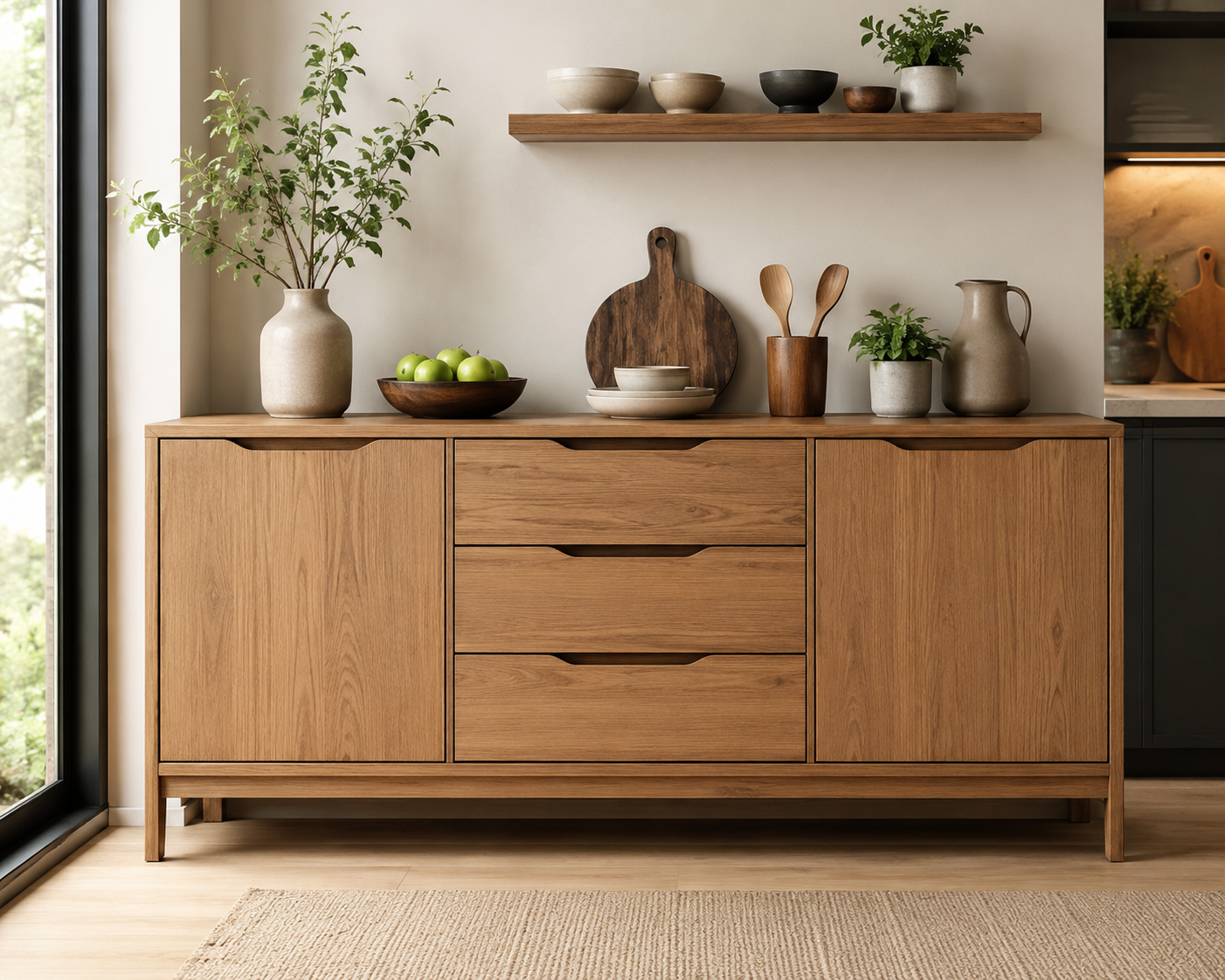
A wood kitchen sideboard cabinet brings warmth that paint can't fake. White oak, walnut and rift-sawn species are leading right now. The grain becomes part of the design, so you don't need busy detailing or fancy hardware to make the piece feel custom. In a kitchen full of painted cabinetry, a wood sideboard adds the contrast the room is usually missing.
Kitchen Sideboard Cabinets in Different Sizes
Kitchen sideboard cabinets come in a wider range of sizes than most homeowners realize. Sizing is where planning usually goes sideways, so it's worth being honest about how much room you actually have versus how much you want to fill.
Small Kitchen Sideboard Cabinet
A small kitchen sideboard cabinet (roughly 36 to 48 inches wide) fits where you wouldn't expect furniture to go. Breakfast nooks, the wall by the back door, that stretch between the pantry and the fridge. Don't write them off. With smart interior dividers, a 42-inch sideboard can hold a full set of dinnerware, flatware for ten guests, and still leave room for serving pieces.
Large Kitchen Sideboard Cabinet
A large kitchen sideboard cabinet (60 inches and up) really earns its keep in open-concept kitchens. There's room for a beverage fridge, two stacks of plates, drawers for flatware and a permanent coffee station on top. If you entertain regularly or run a busy family kitchen, the extra footprint pays for itself quickly.
Tall Kitchen Sideboard Cabinet
A tall kitchen sideboard cabinet pushes vertical, often with a hutch top or open shelving above the base. These work when you want display space without committing to a full run of upper cabinets. Popular in Murfreesboro and Columbia homes where ceilings are higher and the room needs a real vertical anchor. Just watch the proportions, because tall pieces can dominate a small room quickly.
Kitchen Sideboard Cabinet with Drawers vs. Doors
A kitchen sideboard cabinet with drawers is hands-down the most useful configuration for daily life. Drawers handle flatware, napkins, table runners and the small stuff that gets lost on a shelf. Soft-close runners with full-extension slides and proper dividers turn that space into real storage instead of a chaos zone.
Doors handle the bigger items: serving bowls, pitchers, slow cookers, stacks of plates. Behind doors, adjustable shelves let you reconfigure as needed without committing to a fixed layout.
The sweet spot for most homeowners is a mix. Two or three drawers across the top, cabinet doors below. That single layout handles roughly 90 percent of real-world kitchen storage without overthinking it.
Kitchen Buffet Sideboard Cabinet for Entertaining and Daily Use
A kitchen buffet sideboard cabinet leans longer and deeper than a standard sideboard, built specifically with serving in mind. The top surface comfortably holds a full holiday spread. The interior is configured for larger serving pieces, stacked plates and oversized bowls. If your family gathers around food four or five times a year (and most Tennessee families do), this is the configuration to look at first.
The same piece doesn't have to be a holiday-only fixture. A kitchen sideboard buffet cabinet that handles Thanksgiving can also stage your morning coffee, a weekday breakfast buffet or a Friday-night wine setup. Plan the interior right, and you get a piece that pulls daily duty without losing its formal-occasion polish.
Kitchen Sideboard Storage Cabinet: Interior Fittings That Earn Their Keep
A kitchen sideboard storage cabinet earns its name when the interior is planned, not random shelves and prayer. The exterior is furniture. The interior is the tool.
The fittings worth considering: pull-out trays for serving platters that usually live flat and forgotten, a pegged drawer for stacking plates without chips, a wine rack sized for the bottles you actually buy (not the showroom-standard ones), hidden charging stations for phones and tablets, and a flip-down panel for a tucked-away bar setup.
A kitchen storage cabinet sideboard built around your real life looks like a luxury piece because every interior inch is doing something specific. Write down what currently lives in cluttered corners of your kitchen (the slow cooker, the stand mixer, the holiday platters, the linen napkins) and design around that list. Generic interiors look generic, no matter how nice the exterior.
DIY Sideboard from Kitchen Cabinets: A Practical How-To
A DIY sideboard from kitchen cabinets is one of the better weekend projects if you're handy. You can pull it off with stock cabinets from a home improvement store, basic tools and a fair amount of patience. The savings versus custom can be significant if your time isn't billable and the result reads as a real piece of furniture from a few feet away.
Choosing the Right Base Cabinets
A sideboard from kitchen cabinets only looks good if the bases are right. Two 24-inch wall cabinets work well for furniture-height proportions. Base cabinets give you full counter-height but need more reinforcement underneath and usually look more like cabinets-on-the-floor unless you really commit to the finishing. Skip the cheapest stock units. The side panels are usually too thin to wrap cleanly with finished sides and the doors warp within a year or two. Mid-tier boxes look twice as expensive once finished.
Step-by-Step Build Process
Here's how to make a sideboard from kitchen cabinets in the right order:
Build a sturdy plinth from 2x4s, raised three to four inches off the floor. This is the step that separates a real-looking sideboard from cabinets parked on a slab.
Set the cabinets on top of the plinth and clamp them together side by side.
Drill and bolt through the adjoining side panels to lock the boxes into one unit.
Wrap the exposed sides with thin plywood or beadboard so nothing reads as raw cabinet exterior.
Add a real top: butcher block, hardwood slab, quartz remnant, or a stained plywood top with hardwood edging.
Install hardware last, after everything else is finished.
To turn kitchen cabinets into sideboard form successfully, the plinth and the side wrap are the two steps that matter most. Skip either one, and the piece reads as exactly what it is.
Finishing Touches That Sell the Look
A sideboard made from kitchen cabinets gets sold by the details. A real hardwood top with a slight overhang. Quality hardware (no bargain pulls). Turned legs or bun feet that match the room's style. Painted or stained sides that hide the cabinet origin completely. A piece of trim or beadboard across the back if it'll be visible. These small choices separate a DIY that looks DIY from one that passes easily for custom.
Custom vs. DIY: Which Path Makes Sense for Your Kitchen
DIY makes sense when you've got the time, the tools, and a tolerance for trial and error. Custom makes sense when you want exact dimensions for your wall, finishes that match your existing kitchen, interior fittings sized to your actual storage needs, and zero weekend hours spent learning new skills.
There's no wrong choice. The DIY route saves money and gives you a piece with a story. The custom route saves time and gets you closer to exactly what you pictured. If you're already planning a kitchen design, folding the sideboard into the same project lets finishes, hardware, and proportions all line up without negotiation later.
Sideboard Kitchen Cabinet Builds Across Middle Tennessee
We've built sideboards for homeowners for Kitchen remodeling Nashville, TN, Franklin, Brentwood, Spring Hill, Thompson's Station, Columbia and Murfreesboro that started as "we just need a little extra storage" and ended up being the favorite piece in the house. Whether it's a tucked-in dry bar, a long buffet for hosting or a small piece for a breakfast nook, the right sideboard quietly changes how the whole kitchen works.