Outdoor Kitchen Cabinets: The Complete Guide to Choosing Yours
Outdoor kitchen cabinets are weather-resistant storage units built for open-air cooking spaces, designed to hold grills, sinks, refrigerators and cookware while handling rain, humidity, UV rays and temperature swings without warping, rusting or breaking down. If you're setting up a backyard cook station in Nashville, Franklin, or anywhere across Middle Tennessee, the cabinets you pick will decide how long the whole setup lasts and how good it looks five years in. There are more options today than there used to be, and not all of them hold up the way the marketing copy promises. This guide walks through materials, layouts, and the trade-offs that actually matter.
The best outdoor kitchen cabinets are made from four materials that survive weather without warping or rusting:
304 or 316 grade stainless steel - best overall durability, 20+ year lifespan
Marine-grade polymer (HDPE) - best value, won't rot, ideal near pools
Aluminum - lighter than steel, corrosion-proof, dents more easily
Sealed teak or cedar - best looks, needs annual oiling to hold up
Materials to avoid: MDF, particleboard, cheap 430-grade stainless, and thin powder-coated steel. These fail in Tennessee humidity within 2 to 5 years.
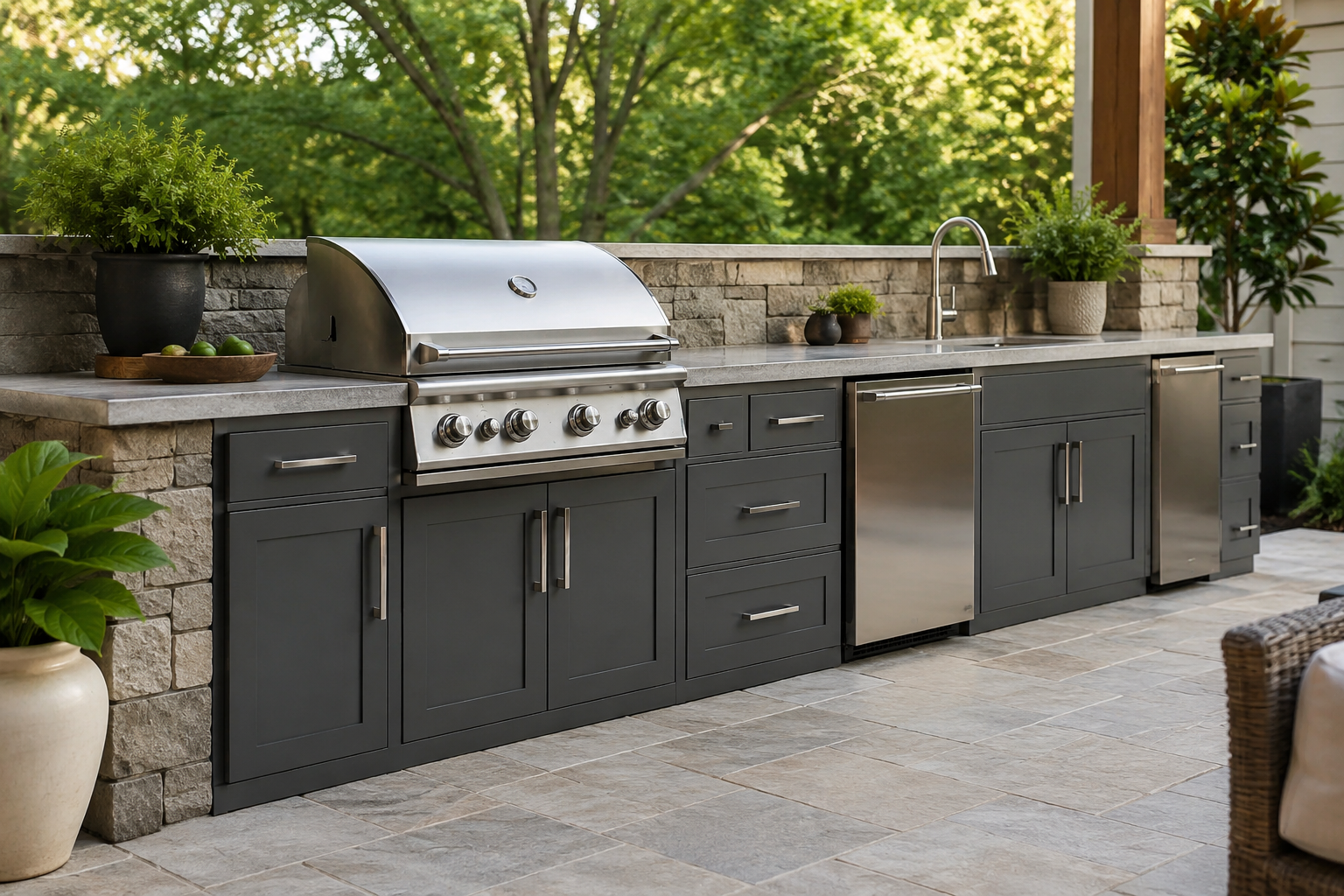
What Outdoor Kitchen Cabinets Actually Do
At the simplest level, they store your stuff and give the grill something to sit inside. But a good outdoor cabinet system does more than that. It hides plumbing lines for your sink, protects your propane tank from view, holds a mini fridge at counter height and keeps utensils and serving platters dry between cookouts. The nicer setups even have soft-close drawers and dedicated slots for trash and recycling.
The catch is that outdoor cabinets face conditions your indoor kitchen never will. A summer thunderstorm, morning dew, chlorine mist off a nearby pool or a hard freeze in January can wreck cabinetry that wasn't built for it. That's why material choice matters so much.
Best Materials for Outdoor Kitchen Cabinets
There's no single right answer here, but the four materials that actually perform outdoors are stainless steel, marine-grade polymer (HDPE), aluminum and properly sealed hardwoods like teak or cedar.
Stainless steel is the workhorse. It shrugs off rain, resists rust when you buy the right grade and cleans up fast. HDPE, sometimes sold as marine-grade polymer, is essentially a dense plastic that looks like painted wood but never rots or warps. Aluminum is lighter than steel and won't corrode, though dents show more easily. Teak and cedar can look stunning, but they need annual oiling to stay that way. Skip anything with MDF or particleboard cores. It doesn't matter how good the exterior finish is. Once moisture gets in, the whole box swells and fails.
Powder-coated steel sits in a gray zone. It looks great new and costs less than stainless, but any chip in the coating starts a rust point that spreads. If you go that route, plan to touch up scratches immediately.
Stainless Steel Outdoor Kitchen Cabinets
Stainless steel outdoor kitchen cabinets are the most common choice for a reason. They handle heat from nearby grills, resist most stains, and pair well with almost any countertop material. When you shop for stainless, look for the grade. 304 stainless is what you want for anything near saltwater or a pool. 316 marine grade is even better if your budget allows. The cheap 430 stainless you'll find on discount grill islands does rust, and quickly, especially in humid Tennessee summers.
Brushed finishes hide fingerprints and light scratches better than mirror polish. Also check the hinges, hardware, and screws behind the doors. Some manufacturers save money by using regular steel fasteners inside a stainless shell, and those are the parts that fail first. A quick magnet test on the internal hardware tells you what you're actually buying.
Modular vs Custom Outdoor Kitchen Cabinets
Modular outdoor kitchen cabinets come in standard widths and heights, ship in boxes and get assembled in your yard. They're faster and cheaper than custom, and for a straightforward layout with a grill, a sink cabinet and some drawer storage, they work fine. Brands sell them as complete kits with matching finishes, so the visual result is consistent.
Custom outdoor kitchen cabinets get built to fit your exact space. If your patio has an odd angle, a low header or you want a corner cabinet that wraps into an L-shape, custom is the only path. You also get to choose materials, hardware, and finishes without being locked into whatever the modular brand offers. The trade-off is time and cost. A custom build takes weeks longer and usually runs 30 to 60 percent higher.
For homeowners in Brentwood or Franklin who want their outdoor kitchen to actually match the architecture of the house, custom typically wins. If you just need something functional near a pool deck, modular gets you there faster. Both approaches show up in our custom cabinetry work at SH Design Woodcraft, and the right pick depends on the space more than personal preference.
Waterproof and Weatherproof Outdoor Kitchen Cabinets
Waterproof outdoor kitchen cabinets aren't really waterproof in the submarine sense. What people mean by that phrase is that water doesn't damage them, doesn't pool inside them and doesn't cause slow-motion failure over the seasons. The details that matter are drainage holes at the bottom of each box, sealed seams between panels and hardware that drains rather than traps moisture.
Weatherproof outdoor kitchen cabinets go a step further. Good ones include UV-stable finishes that don't chalk or fade after two summers, gasket seals around doors to keep dust and pollen out, and expansion gaps that let the material breathe as temperatures shift. In Middle Tennessee, we get freeze-thaw cycles a few times a winter, and cabinets without expansion room can crack at the joints.
Countertops matter too, even though they're a separate item. Granite, quartzite, and concrete all handle outdoor conditions well. Skip standard quartz, since the resin binder isn't rated for direct sun and will yellow.
Outdoor Kitchen Cabinet Ideas and Layouts
The most popular layout is a straight run with a grill in the middle, cabinets on either side, and a sink or side burner on one end. It's efficient and works on most patios. An L-shape adds a return that can hold a fridge or a prep counter. A U-shape gives you the most storage but needs more square footage.
A few ideas worth considering. A dedicated outdoor kitchen sink cabinet with pull-out trash makes cleanup dramatically easier. A tall pantry cabinet, even a small one, keeps paper towels and grill tools dry and off the counter. Drawer bases beat door cabinets for anything you use often, since bending down to root through a dark box gets old fast. And if you cook with a smoker or kamado, plan a ventilated cabinet slot for it rather than parking it separately.
For finishes, matte black is having a moment and pairs well with wood accents. Wood-grain HDPE lets you get the warmth of wood without the maintenance.
DIY Outdoor Kitchen Cabinets vs Hiring a Pro
DIY outdoor kitchen cabinets are absolutely possible if you're comfortable with framing, tile work, and appliance installation. Concrete block boxes with stone veneer are the classic DIY approach, and they last decades if built well. HDPE panel kits with pre-cut components have made DIY more accessible for people without carpentry backgrounds.
Where DIY gets tricky is anything involving gas, water, or electrical. Running a natural gas line to a built-in grill needs a licensed plumber in Tennessee, and hard-wiring a fridge or side burner needs an electrician. The cabinets themselves might be a weekend project. The utilities behind them usually aren't.
If you want the finished result to hold value when you sell the house, a professional install with permits and documented gas and electrical work is the safer path.
Outdoor Kitchen Cabinets Near Me in Middle Tennessee
For homeowners searching for outdoor kitchen cabinets near me across Kitchen remodeling Nashville, TN,Franklin, Brentwood, Spring Hill or Murfreesboro, Thompson's Station, and Columbia, local build matters more than it does for indoor cabinetry. A local shop knows what the humidity does to finish here, which materials survive our storms, and how to work around HOA rules in specific neighborhoods.
If you're weighing options, browse more of our kitchen and cabinetry projects to see how outdoor builds fit into the broader design of a home. The best outdoor kitchens don't feel bolted on. They read as an extension of the space you already live in.
Ready to Plan Your Outdoor Kitchen Build?
Start with your grill. Its dimensions and clearance requirements set the framework for everything else. From there, work outward in this order: prep space (24 to 36 inches on either side of the grill), storage cabinets sized to what you actually cook, then utilities like gas, water, and power.
A quick planning checklist before you buy anything:
Measure the patio slab, note where drainage runs, and mark where the grill will vent.
Confirm gas line access. Running a new line adds $600 to $1,500 in Middle Tennessee.
Decide on countertop material before the cabinets ship, so cutouts line up.
Ask your builder for a 10-year material warranty in writing, not just the sales sheet.
Local build matters more than it does for indoor cabinetry. A local shop knows what Middle Tennessee humidity does to finish here, which materials survive our spring storms, and how to work around HOA rules in specific neighborhoods.
We serve homeowners across the region for outdoor and indoor cabinetry work:
If you're weighing options for your outdoor kitchen build, browse our kitchen remodel before-and-after gallery or start with our custom kitchen design services. The best outdoor kitchens don't feel bolted on. They read as an extension of the space you already live in.