LED Under Cabinet Lights for Kitchen: Complete Buyer's Guide
LED under cabinet lights for kitchen counters are low-profile fixtures installed beneath upper cabinets to light the countertop workspace directly below. They come in flexible strips, rigid bars, thin tape, and small puck shapes, and they fix the biggest lighting problem in almost every kitchen: shadows on the surface where you actually work. Whether you are updating a builder-grade kitchen in Franklin or planning a full remodel in Nashville, this upgrade changes how a kitchen looks and how it feels to cook in.
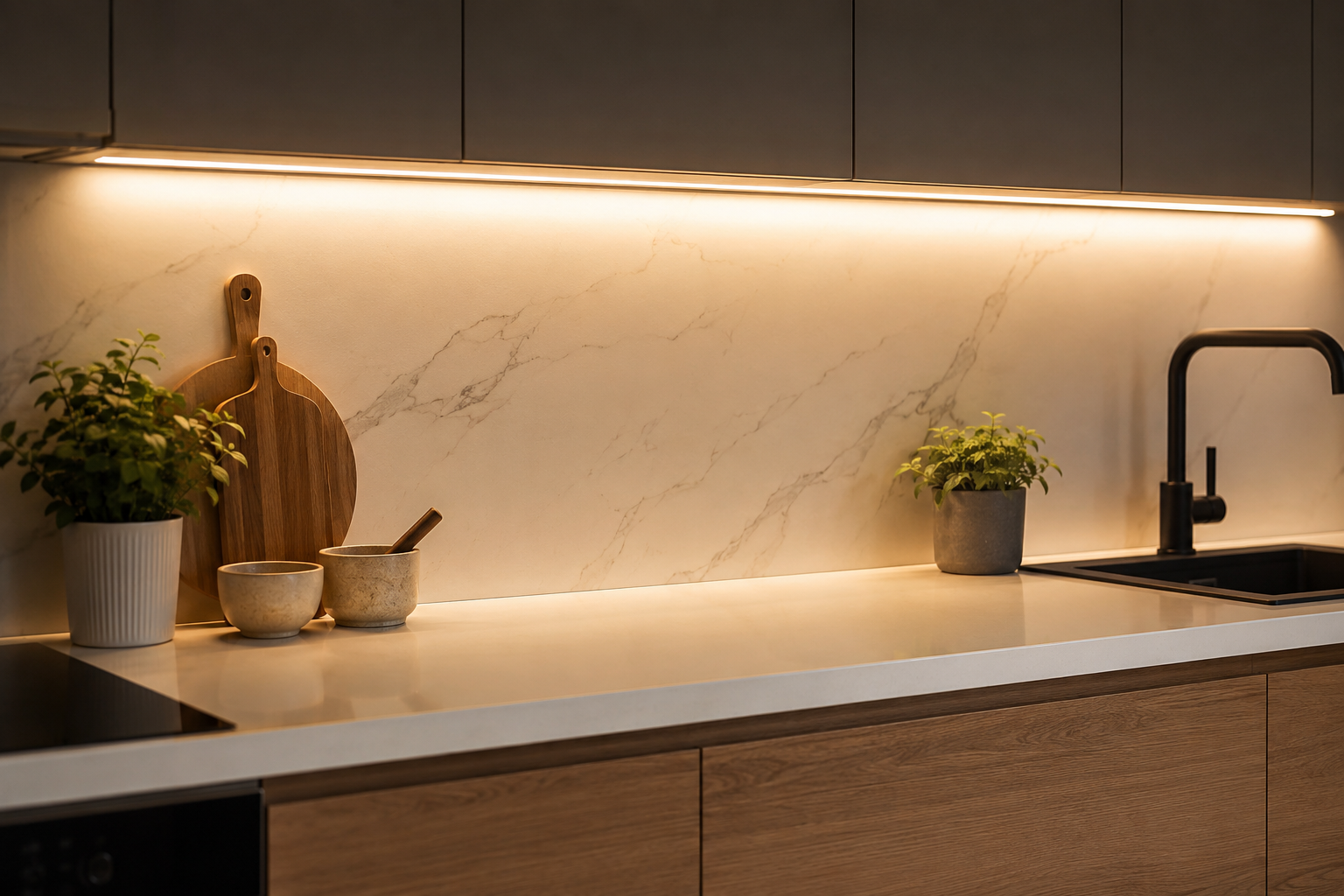
Most homeowners underestimate how much daily use a countertop gets. Overhead lights create shadows because upper cabinets block the light before it reaches the counter. LED under cabinet lighting sits below those cabinets and washes the surface with even brightness. The result is a workspace that feels bigger, cleaner, and more usable, day or night.
Why Under Cabinet LED Lights for Kitchen Spaces Matter More Than You Think
Good under cabinet lighting does three jobs at once. It gives you task lighting for prep work, adds a soft ambient glow for evenings, and highlights your backsplash or countertop as a design feature.
Older kitchens often relied on a single ceiling fixture. That approach leaves the counter half-shadowed, especially near the stove and sink. LED strips and bars fix that instantly. They also run cool, use very little electricity, and last 25,000 to 50,000 hours. Run them four hours a day, and that is roughly 17 to 34 years before you replace them.
For a full picture of how lighting fits into a larger remodel, see ourkitchen design services.
Best LED Lights for Under Kitchen Cabinets: The Main Options
The best LED lights for under kitchen cabinets fall into four categories, each with a specific strength.
LED strip lights: Flexible ribbons of tiny LEDs on adhesive backing. Easy to cut to length. Best for continuous, even light across long cabinet runs.
LED tape lights: A thinner, more polished version of strip lights. Very low profile. Good when you want the light source hidden from view.
LED light bars: Rigid aluminum housings with LEDs inside. Sturdier, easier to mount straight and often the go-to for hardwired installs.
Puck lights: Round spots that create pools of light. Best used sparingly or on shorter cabinet sections.
For most Middle Tennessee homes we work on, we recommend a combination: strip or tape lights across the main prep runs, plus a puck or two over a specific focal point like a coffee station.
LED Light Strips for Under Kitchen Cabinets: What to Look For
LED light strips for under kitchen cabinets are the most flexible option on the market. They come in 12V or 24V, plug-in or hardwired, and lengths from 3 feet up to 32 feet on a single roll. The specs that actually matter are lumens per foot, color temperature, and CRI.
For kitchen work, aim for 200 to 400 lumens per foot. Anything less feels dim on darker countertops. A color temperature of 2700K to 3000K gives a warm, home-like glow. Around 3500K to 4000K gives a cleaner, neutral light that shows true colors well. Skip anything above 5000K in a kitchen. It reads blue and cold on the counter.
CRI, or color rendering index, matters more than most people realize. A CRI of 90 or higher means food looks like food and paint colors read the way they should. Cheap strips often sit at CRI 80, which is passable, but tomatoes look slightly gray and greens look tired.
Well-built cabinet work also leaves clean surfaces for mounting, which makes strip installs faster and cleaner. See real examples on ourstyle and color page.
Are LED Strip Lights Good for Under Kitchen Cabinets?
Yes, LED strip lights are a strong choice for under kitchen cabinets, and for most kitchens they are the best all-around option. They are affordable, easy to install, energy-efficient, and available in almost any length or color temperature.
The things to watch for are adhesive quality (cheap strips peel after a year or two), driver location (bulky drivers need a place to hide), and diffuser cover (a frosted channel prevents visible dots of light showing up on a glossy backsplash).
If you cook often and want clean, even light without visible bright spots, invest in strips with a built-in aluminum channel and diffuser. It costs a little more upfront and looks far more finished for years after.
LED Strip Lighting for Under Kitchen Cabinets: Wired vs Plug-In
LED strip lighting for under kitchen cabinets comes in two main power setups, and picking the right one before you buy saves a lot of frustration later.
Plug-in strips are the easy option. Attach the strip, run the wire to a nearby outlet, and you are done. Good for renters, quick upgrades, or anyone who does not want to hire an electrician. The visible cord is the main downside.
Hardwired strips connect to your home's electrical, controlled by a wall switch or smart controller. Cleaner look, no visible cords, and easier to link with the rest of your kitchen lighting scenes. This route usually requires a licensed electrician and adds a few hundred dollars to the install, but for a real remodel it is worth it.
Homeowners doing a complete kitchen renovation in Kitchen remodeling Brentwood, TN or Kitchen remodeling Nashville, TN almost always go hardwired. The wiring gets run through the wall while the cabinets are being installed, so nothing shows in the finished kitchen.
LED Tape Lights for Under Kitchen Cabinets: The Low-Profile Choice
LED tape lights for under kitchen cabinets are similar to strip lights but slimmer and more discreet. Most tape lights measure around 8mm to 10mm wide and less than 3mm thick. They tuck into a recessed lip on the underside of the cabinet where you cannot see them from any standing angle.
Tape lights are the go-to choice when the cabinet has a shallow lip or when the homeowner does not want any hardware to be visible. They are also the cleanest option under glass-front upper cabinets, where a bulky bar would show through and ruin the look.
LED Light Bars for Under Kitchen Cabinets: When to Choose Them
LED light bars for under kitchen cabinets are the rigid alternative to flexible strips. They come pre-housed in aluminum, usually with a built-in diffuser, and mount with screws or double-sided tape. Because they are rigid, they install perfectly straight without any wave or sag.
Light bars work well when:
The cabinets have a deep recess where a bar can hide flush
The homeowner wants a plug-and-play install with fewer components
The kitchen has short cabinet sections that do not need custom cutting
They cost slightly more per foot than strip lights, but the install time is faster and the finished look is very consistent. For remodels inFranklinandSpring Hill, light bars are popular with homeowners who want a set-and-forget setup.
Battery LED Lights for Under Kitchen Cabinets: When They Actually Make Sense
Battery LED lights for under kitchen cabinets have improved a lot in the last few years. Modern rechargeable versions run on lithium batteries and stay lit for 8 to 12 hours per charge. Motion sensor models turn on when you walk near the counter, which is handy for a nighttime glass of water without flipping a switch.
Battery operated LED lights for under kitchen cabinets are best for:
Rentals where drilling or hardwiring is not allowed
Older kitchens with no nearby outlets
Cabinets in a pantry or island where wiring would be a pain
Trial runs before committing to a full hardwired setup
The downside is charging. A busy household with lights on all evening will need to swap or recharge units every few days. For daily use in a working kitchen, hardwired is still the better long-term investment. Battery LED strip lights for under kitchen cabinets work well as a stopgap or a targeted accent, but they rarely stay as the permanent solution once you get used to real coverage.
How to Choose the Right LED Under Cabinet Lighting for Your Kitchen
A quick checklist before you buy:
Length: Measure the underside of each cabinet run. Add every run together, then add a foot of slack. Strip lights are sold in fixed lengths, so round up rather than down.
Lumens: Aim for 200 to 400 lumens per foot for solid task light. Below 150 lumens per foot feels decorative rather than functional.
Color temperature: 2700K to 3000K for warm and cozy. 3500K to 4000K for clean and bright. Match it to the rest of your kitchen lighting so nothing clashes.
CRI: Look for 90 or higher. It is the single spec that separates a professional look from a big-box store look.
Dimmable: Almost always worth it. Full brightness for prep, low glow for late evenings.
Diffuser: A frosted aluminum channel over strip lights hides the individual LEDs and stops hot spots on your backsplash.
Installation Tips That Save Time and Regret
A few things we have learned from installing under cabinet lighting on hundreds of kitchens across Middle Tennessee.
Clean the mounting surface with rubbing alcohol before pressing adhesive strips into place. Grease from cooking is invisible but wrecks the bond within weeks.
Mount the light toward the front edge of the cabinet underside, not the back. That throws light forward onto the counter rather than up onto the backsplash tile.
Hide the driver and wiring inside the cabinet above, not below. Cutting a small hole in the cabinet floor and routing the wire up keeps everything invisible.
Test the run before permanently mounting. Peel and stick works once. A bad angle or a strip that shows too much means starting over with a new strip.
For gut renovations inMurfreesboro, Columbia orThompson's Station, we run the wiring during the cabinet install phase. That way the finished kitchen has no visible cords, no adhesive edges, and no compromises.
Common Mistakes to Avoid
Buying the cheapest strip on Amazon. The savings vanish when the strip fails in 18 months or the color shifts to a greenish yellow.
Skipping the diffuser. Uncovered LEDs create dot patterns and reflections on shiny counters and glass backsplashes. It looks amateur no matter how nice the cabinets are.
Mixing color temperatures across the kitchen. Two warm strips and one neutral bar under different cabinets makes the whole space feel off.
Overpowering the space. 800 lumens per foot on a glossy quartz counter is blinding at night. More light is not always better.
Ignoring dimming. A single-brightness kitchen looks great during the day and harsh after dinner.
See What Good Under Cabinet Lighting Looks Like in Real Kitchens
If you are still deciding, browse our kitchen remodel before and after photos. You can see how the lighting shifts the whole feel of a space. A gray shaker kitchen with warm strip lights reads cozy. The same cabinets with cool neutral bars read modern. Same kitchen, different mood, thanks to what is tucked under the wall cabinets.
For new construction projects and builders looking to integrate lighting during the cabinet phase, take a look at our custom cabinetry page.
Ready to Upgrade Your Kitchen Lighting?
LED under cabinet lights are the smallest change with the biggest visual payoff in a kitchen. They cost less than new hardware, install in a weekend for plug-in versions, and change the way the whole room feels the moment they come on. If you are planning a bigger remodel or want the lighting fully integrated into custom cabinets, contact us or give us a call at (615) 968-3090. We serve homeowners across Nashville, Brentwood, Franklin, Spring Hill, Columbia, Thompson's Station, and Murfreesboro with design-build kitchen remodeling that includes lighting done right from the start.