Kitchen Remodel Design: How to Plan Every Detail Before You Pick a Single Cabinet
Most people walk into a kitchen remodel thinking they know what they want white cabinets, new countertops, maybe an island. Then, three weeks in, they're standing in their gutted kitchen realizing they never thought about where the trash pull-out goes or whether the sink placement actually makes sense for how they cook.
That's what a real kitchen remodel design process is supposed to prevent.
This guide covers how to design your remodel the right way from understanding your layout constraints to choosing the right tools, hiring the right team, and making decisions that hold up ten years from now. Whether you're a first-timer or you've been through it before, this is the part most contractors skip.
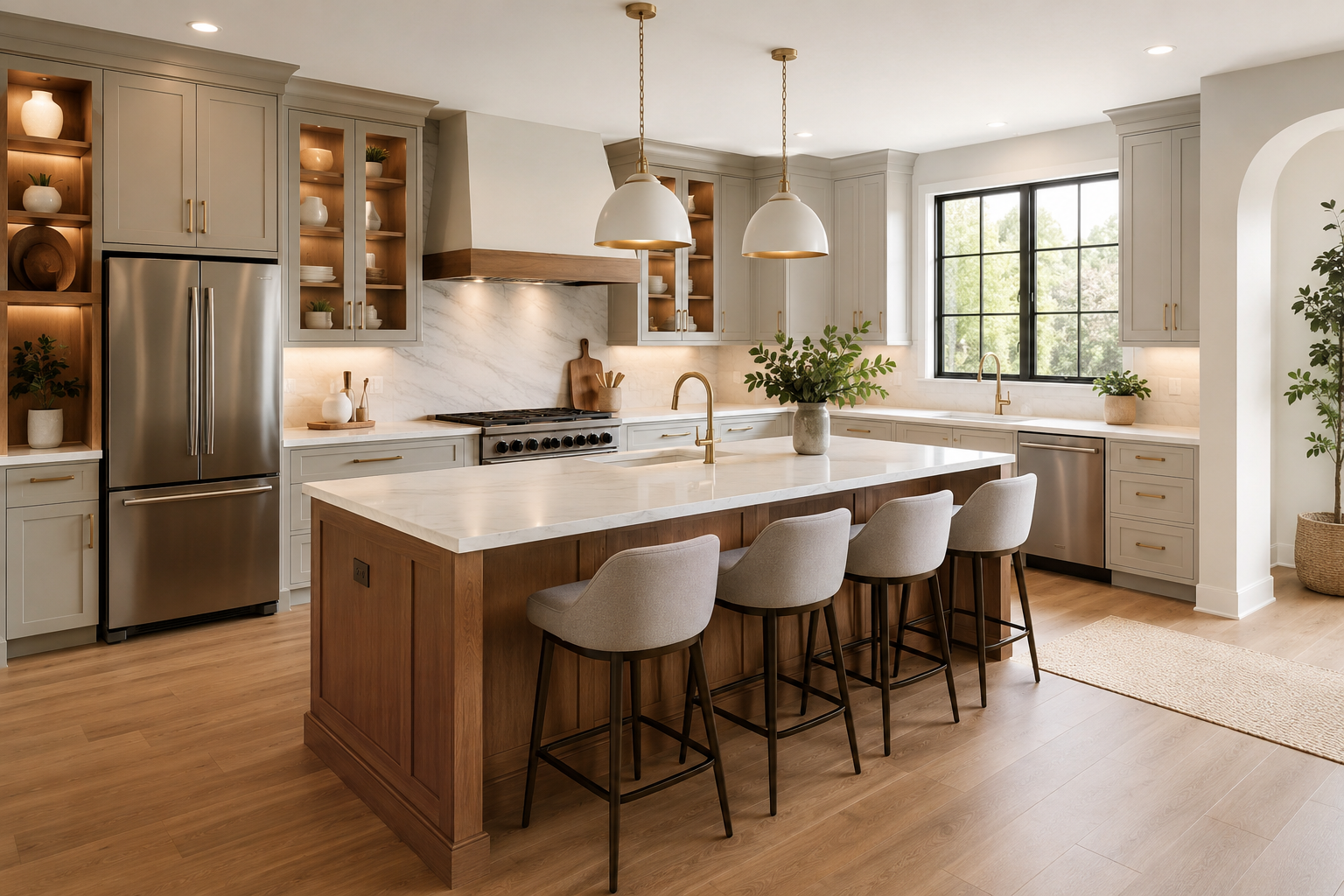
Why Kitchen Remodel Design Decisions Come Before Budget Decisions
Most homeowners do it backwards. They set a number, then try to squeeze a design into it. The smarter approach is to design the kitchen you actually need, then value-engineer from there.
When you start with kitchen design and remodel goals workflow, storage, aesthetics, natural light your budget conversations become specific. You're not asking "can we afford new cabinets?" You're asking "does replacing the cabinet boxes justify the cost versus refacing them, given our resale timeline?"
That's a question a real kitchen remodel design consultation answers. A vague budget conversation doesn't.
Here's what good early-stage kitchen design remodel planning actually resolves:
Traffic flow Where does everyone walk when two people are cooking? Where do kids cut through to get to the backyard? The work triangle (sink, stove, fridge) matters, but traffic flow matters more in real family kitchens.
Storage logic Most kitchens have enough cabinet square footage. They just have it in the wrong places. Upper cabinets above the stove that nobody can reach. Deep base cabinets without pull-outs that become black holes. Good kitchen remodel design ideas fix the logic, not just the look.
Plumbing and electrical reality Moving a sink costs money. Moving a gas line costs more. Your design a kitchen remodel plan should account for what's already in the walls before you fall in love with a layout that requires a $4,000 plumbing rough-in.
If you're working with a firm that offers kitchen remodel design services, they should be walking you through these decisions in writing before any demolition happens.
How to Design a Kitchen Remodel The Right Sequence
The single biggest mistake in how to design a kitchen remodel is jumping to the aesthetic layer before the functional layer is locked in.
Here's the sequence that actually works:
Step 1: Audit what you hate about your current kitchen. Not what looks dated what frustrates you functionally. Not enough counter space? Nowhere to put groceries when you walk in? No natural light? Write it down. This becomes your design brief.
Step 2: Lock your layout before touching finishes. There are five basic kitchen layouts galley, L-shape, U-shape, G-shape, and open plan. Each has a different ceiling for how much counter and storage you can realistically get. Your kitchen remodel design should start here, not at the cabinet door profile.
Step 3: Set your cabinet spec first, everything else second. Cabinets consume 35–45% of most remodel budgets. They're also the hardest to change later. Whether you're going custom, semi-custom, or stock shapes everything downstream countertop overhangs, appliance gaps, hardware clearances.
At SH Design Woodcraft, every project starts with a full-space audit before we talk about door styles. That's not because we don't care about aesthetics it's because aesthetics without function produces beautiful kitchens nobody wants to cook in.
Step 4: Set your countertop and backsplash after cabinets are specced. Quartz, granite, quartzite, butcher block each has different edge profiles, seam logic, and maintenance requirements. Don't choose your countertop in a vacuum. Choose it in relationship to your cabinet color and your lifestyle.
Step 5: Lighting last, but not as an afterthought. Recessed cans, under-cabinet task lighting, pendant fixtures over an island these should be on your electrical plan before drywall goes up, not added as an afterthought when the ceiling is already closed.
That's the sequence. How to design an energy-efficient kitchen remodel adds one more layer: think about appliance placement relative to windows (natural light reduces lighting loads), and specify LED under-cabinet lighting and Energy Star-rated appliances early so the electrical rough-in is sized correctly.
Kitchen Remodel Design Tool and Software Options What's Actually Worth Using
There's no shortage of kitchen remodel design tool options. The question is what they're actually good for versus where they fall short.
Free browser-based tools
A kitchen remodel design tool free option like IKEA's Kitchen Planner or RoomSketcher's basic tier lets you drop cabinets into a floor plan and get a rough spatial sense of your layout. They're useful for early ideation especially if you want to test whether an island realistically fits but they don't model real cabinet dimensions accurately, and they don't account for soffit heights, window trim depths, or appliance clearances.
Use them to test concepts. Don't use them to finalize anything.
Paid kitchen remodel design software
Professional kitchen remodel design software like 2020 Design, Chief Architect, or Cabinet Vision is what actual designers and kitchen remodel design and build firms use. These tools model real products, real dimensions, and real material costs. If a contractor is presenting you a design from one of these platforms, the drawings are accurate enough to build from. If they're showing you a SketchUp model or a Houzz board, that's inspiration, not a construction document.
Virtual and AR tools
Kitchen remodel virtual design tools including augmented reality apps that overlay cabinets on your actual phone camera view have gotten genuinely useful in the last two years. They're best for visualizing door colors and finishes in your actual lighting conditions. Showroom lighting lies. Your phone camera in your kitchen doesn't.
A kitchen remodel design app like Houzz or Planner 5D can get homeowners 70% of the way to a visual concept. The remaining 30% the part that determines whether it actually works still requires someone who has built kitchens before.
Kitchen Remodel Design Ideas That Competitors Won't Tell You About
Most kitchen remodel design ideas content online is essentially a Houzz gallery with captions. Here's what actually moves the needle on both function and resale value.
The hidden cabinet dead zone. The corner between two base cabinet runs typically a blind corner or lazy Susan is where storage efficiency collapses. The best kitchen design and remodel projects either replace that corner with a pull-out Magic Corner unit or rethink the layout entirely to eliminate the dead zone. Most renovation content ignores this completely.
Drawer-over-door base cabinets. Replacing standard door-and-shelf base cabinets with all-drawer configurations is the single highest-impact storage upgrade in any kitchen design remodel project. You gain full-depth access to everything. No more kneeling. No more items disappearing behind doors. This is now the industry standard in high-end kitchen design and remodel projects and it needs to become the standard in mid-range remodels too.
The countertop-to-window sill relationship. If your countertop runs under a window, the sill height determines whether you can have upper cabinets flanking that window or not. Most remodel kitchen design content never mentions this but it's one of the first things a structural review will flag.
Workflow zones vs. work triangle. The classic work triangle (sink-stove-fridge) was designed for single-cook kitchens in the 1940s. Modern kitchen planning uses a zone model instead: prep zone, cook zone, cleanup zone, beverage zone, and pantry zone. A kitchen remodel design company worth hiring thinks in zones, not triangles.
Cabinet height to ceiling. Standard upper cabinets stop 12–18 inches below the ceiling. That gap collects dust and makes the kitchen feel lower than it is. Extending cabinets to ceiling height or adding a decorative soffit is one of the highest-ROI visual moves in a kitchen remodel design project. Cost is modest. Impact is significant.
Design Build Kitchen Remodel Why It Changes Everything
The traditional model hire a designer, then hire a contractor creates a gap. The designer draws something beautiful. The contractor bids it and immediately starts value-engineering it into something that fits his crew's workflow. You end up negotiating between two people who have different incentives.
A design build kitchen remodel eliminates that gap. One team handles design and construction under a single contract. The design is constrained by what can actually be built. The construction is guided by a design intent, not overridden by it.
This is why design build kitchen remodel firms are growing faster than traditional contractor-plus-designer arrangements in markets like Middle Tennessee. Homeowners get fewer surprises, cleaner handoffs, and a single point of accountability.
For kitchen remodel design and build projects specifically, the design-build model also means your cabinet spec, countertop spec, and finish selections are locked before demolition starts not being decided in the middle of the job when your kitchen is in pieces and your family is eating takeout in the living room.
At SH Design Woodcraft, we operate on a full design build kitchen remodel model. Design and construction are handled by the same team, which means what gets drawn is what gets built no translation errors, no contractor interpretation.
Remodel Kitchen Design Decisions That Affect Your Cabinets Directly
Your cabinet choices and your remodel kitchen design decisions are not separate conversations. They're the same conversation.
Here's how design decisions cascade into cabinet spec:
Ceiling height determines upper cabinet height. Standard upper cabinets are 30 or 36 inches tall. If your ceilings are 9 feet or higher, 42-inch uppers are the right call. Most homeowners don't realize this until the cabinets are already ordered.
Island placement determines base cabinet depth. Standard base cabinets are 24 inches deep. Island base cabinets are often 27 or 30 inches deep sometimes with seating overhangs that require specific structural support. Your kitchen remodel design should specify island depth before the floor plan is finalized.
Appliance specs drive cabinet cutouts. Your refrigerator counter-depth dimension, your range or cooktop cutout, your dishwasher opening all of these need to be on the cabinet shop drawings before manufacturing begins. If you change your refrigerator after cabinets are built, you may be shimming gaps or cutting panels.
Pull-out trash location affects base cabinet run. This sounds minor. It isn't. The pull-out trash drawer typically replaces an 18-inch base cabinet. Where it goes in the run affects your sink cabinet width, your dishwasher placement, and your cleanup zone workflow. Decide this in the design a kitchen remodel phase, not during installation.
Understanding these cascades is exactly why ourkitchen cabinet remodel ideas guide exists because cabinet decisions and design decisions are inseparable.
How Much Does Kitchen Remodel Design and Professional Services Cost?
Here's the part most guides avoid because the numbers are uncomfortable.
Designer fees for a standalone kitchen designer typically run $150–$300/hour, or 10–15% of the total project cost for full-service design. A kitchen remodel design consultation in most markets is $200–$500 for an initial session.
Design-build firms typically fold design costs into the total project contract. You don't pay separately for the drawings the design cost is built into the margin on materials and installation. This works in your favor when the design and construction are genuinely integrated. It can mask costs when they aren't.
Software-based virtual design services some companies now offer kitchen remodel virtual design as a standalone product, typically $500–$1,500 for a full kitchen plan. You get drawings and a 3D render. You don't get someone who will actually build it. This is useful for homeowners who want to bring a finished design to a general contractor.
Free design consultations are common with cabinet retailers and design-build firms (including us). Use them. But understand what you're getting a sales conversation with design elements versus an independent design engagement. Both have value, but they're different things.
For a detailed look at how budget typically distributes across a full remodel, ourkitchen remodel cost estimator breaks down where the money actually goes cabinets, labor, countertops, and everything else.
Kitchen Design and Remodel Near Me What to Look for in Middle Tennessee
If you're searching for kitchen design and remodel near me in Middle Tennessee, here's what actually separates strong firms from weak ones beyond the portfolio photos.
Do they build their own cabinets? There's a significant difference between a firm that orders cabinets from a big-box supplier and one that builds or specs custom cabinetry. Custom and semi-custom cabinets built from solid wood with dovetail joinery and soft-close hardware are not the same product as RTA boxes assembled on a job site.
Do they have a fixed design process? A kitchen design remodel near me contractor who starts with demolition before finishes are locked is going to create change orders. A firm with a documented design-to-build sequence won't.
Do they do their own installation? Subcontracted installation is the single biggest source of quality variance in kitchen remodels. If the firm that designed your kitchen isn't the one installing it, you have an alignment problem.
Do they have real before-and-afters from local projects? Not stock photos. Not renders. Actual projects in homes like yours, in neighborhoods like yours, with before conditions that look like your current kitchen.
We serve homeowners across Middle Tennessee. If you're in the area, every project page on our site is a real project see our kitchen remodel before and after photos andexplore our design services to understand how we approach the design-to-build process.
Kitchen Remodel Design Across Middle Tennessee Where We Work
If you're ready to move from "thinking about it" to "actually doing it," here's where we currently serve:
We handle full kitchen design and remodel projects across the following areas:
NashvilleKitchen remodeling in Nashville, TN from East Nashville bungalows to Green Hills custom homes
BrentwoodKitchen remodeling in Brentwood high-end finishes, custom cabinetry, full design-build
FranklinKitchen remodeling in Franklin, TN custom cabinets and full renovation management
Spring HillKitchen remodeling in Spring Hill our home market, where we've done more kitchens than anywhere else
Thompson's StationKitchen remodeling in Thompson's Station new construction and full remodels
ColumbiaKitchen remodeling in Columbia, TN full-service remodels including cabinet replacement and countertop upgrades
MurfreesboroKitchen remodeling in Murfreesboro growing market, full design-to-installation service
Every location gets the same process: design consultation, locked spec before demolition, custom cabinetry, and a single team handling it start to finish.
If you're ready to talk about your kitchen,contact us or call (615) 968-3090. We'll walk you through what the design process actually looks like for your specific space no sales pressure, no generic quote.